

Trapped in a cycle of danger: blood in the recycling factory
Feature Article
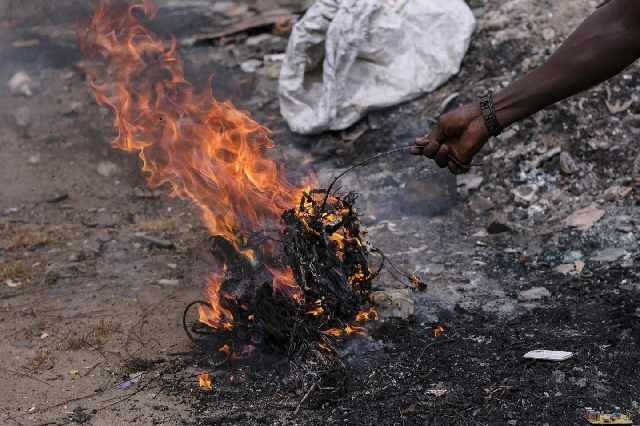 Lesd toxic in the Kpone area of Accra
Amidst the bustling industries and growing local economy in the heart of Tema, Ghana’s largest industrial area, a sombre story unfolds in a lead factory that barely meets safety standards. Fortune, a 33-year-old worker, spent long hours each day amidst toxic fumes and hazardous materials, her only shield being an ill-fitting mask that offers almost no protection.
The company for which she risked her life is Success Africa Ghana Limited, which operates its ULAB facility for lead battery recycling.
Though locked behind tall walls where only a simple sign indicates its presence on a narrow street away from the range of vast factories located on the main road, the air is thick with the smell of chemicals, and the workplace is dimly lit. It is also cluttered with dangerous equipment and spills of molten lead that sometimes splash onto Fortune and her colleagues.
Scientists say the constant exposure to these toxic substances puts her at serious risk of lead poisoning, respiratory problems, and burns. Yet, the factory’s weak safety protocols and lack of proper protective gear leave her and others dangerously vulnerable every day.
“Sometimes, there are no gloves and boots,” says Fortune, who was a supervisor until her dismissal in 2023 for speaking to the press about their working conditions during an inspection visit of the chief executive of Ghana’s Environmental Protection Agency (EPA).
One of the most dangerous moments comes, Fortune says, when the factory melts old batteries to extract lead. During these hazardous processes, molten material often splashes unpredictably, leaving workers like Kwame Fosu covered in burning lead droplets.
The splashes cause painful burns and expose them to even higher levels of toxic lead, risking lifelong health problems with no proper medical treatment available.
For their toil and dangerous labour, they are paid $1.5 per day. And they work eight hours each day.
Henry Kokofu, the then CEO of the EPA, was alarmed at the horrendous conditions under which Fortune and her colleagues worked. He said the state would not “allow production of this magnitude to go on – polluting the air, acid all over the place. You, the workers, the staff, are being subjected to and exposed to hazards. We don't want it to happen to you. You are so precious to the country Ghana. You deserve to work in a very congenial environment just like any other person.”
Local health officials and labour advocates have raised concerns about the dangerous level of exposure in and around the factory, but the lack of regulatory enforcement allows these factories to operate with little regard for workers’ safety. Many workers, including Kwame, lack protective gear, and regular health screenings are nonexistent. The economic pressures and weak laws trap them in a cycle of danger and silence for one of the most sought after products—lead-acid—which is used for making batteries of cars, off-grid solar applications and backup power systems.
All around the factory, brownish water leaks out from the walls. A linear puddle flows into the street facing Success Africa’s entrance, while the rest flows through surrounding gutters that connect with Tema’s open sewage system. This is despite EPA’s order for the factory to enhance its safety protocols following a shutdown in August 2023 for breaching safety protocols.
The Director of the Ghanaian Mountain Research Institute, Dr. Atiemo Sampson, says, “The water from the factory is not supposed to get out. It needs to be treated in-house to meet environmental standards before being released.”
He explains that groundwater testing around the factory in the past showed high acidic levels, which could be caused by the cutting area of the factory, where batteries are cut straight open on the ground. He also adds that in the past, this cutting was “largely contaminated and stained” with lead. These conditions caused the EPA to shut down the factory in November 2023 with a GHS100,000 (equivalent of USD 8,334.79 at the time)
Despite Success Africa having reopened after meeting some of EPA’s conditions for proper sanitary management, Dr. Sampson believes the company still poses health risks to its workers and to the populations living nearby.
Peeping above the factory wall, I could notice some employees waiting by the battery cutting area, not wearing masks. We also observed what appeared to be workers' housing located right next to the factory.
“There are residential apartments within the facility for Indian workers. They’re exposed as well,” explains Dr. Sampson, who had visited the factory during an audit.
Behind the factory, straight next to its wall, we also noticed several houses where children and adults' clothes were drying in the sun. I met Victor, a 22-year-old young man waiting for his brother, who was at school for the day. He told us that about 12 people lived in the house, which shares a wall with the factory.
While Victor was aware of potential health risks associated with living in an industrial area, he did not seem to know the specific risks relating to Success Africa, operating right on the other side of the wall.
“The sound and the smell are mostly the problem. There’s also an oil company here. Sometimes, you can hear a blast at 12 AM. The chemicals from the companies around aren’t good for us,” he said.
Victor and his brother have lived here for four years, but neither of them has ever been contacted by the company or the state to inform them of the potential risks of living next to Success Africa. He says he suffers from intermittent headaches due to the surrounding smell, but has never visited a hospital for a medical assessment for potential contamination from lead. We could not independently confirm this claim.
He is one of the very few to live so close to Success Africa, surrounded mainly by factories and the Kpone landfill site. But farther around and up to a 2km2 radius, more than 20,000 people residing in the area could be potentially exposed to health risks induced by Success Africa’s activity.
“People living there are only concerned about noise pollution. But beyond that, there’s a real risk of contamination,” Dr. Sampson said.
Dr Sampson referred to leached toxins, which he said could contaminate surface water and groundwater sources, affecting aquatic ecosystems and damaging the kidneys, nervous system, and reproductive systems.
Scientists say this can have serious impacts on health, including irreversible nerve damage and developmental delays in children.
A United Nations report in January 2025 estimates that over 55 million children have blood lead levels that exceed 10 micrograms per decilitre (µg/dL), in Sub-saharan Africa, twice the threshold deemed dangerous by the World Health Organization (WHO).
And many children, the UN report says, are exposed through direct contact, breast milk, and even as developing foetuses when pregnant mothers come into contact with lead. Globally, the United Nations’ Children's Fund ( UNICEF) said “lead exposure kills 1.5 million people each year—more than annual deaths from HIV and malaria combined—and the vast majority of these are in low-and middle-income countries.”
Besides causing fevers and gastrointestinal problems, lead damages the intellectual development of young children, reducing IQ and attention span, as well as causing mood disorders. It creeps into the body when someone breathes polluted air or swallows a tainted liquid or food, paint chips, soil or dust. It then settles in organs and teeth and breaks down cells that protect the body, having moved through the bloodstream.

Source: Ghana Health Service 2024 Blood Lead level(BLL) study of polluted areas.
A Blood Lead levels study led by the Ghana Health Service and partners between November 2022 to January 2024 observed widespread lead exposure among children aged 12-59 months within 2km radius of the Success Africa factory. This yet-to-be published first-ever study obatined by The Examination was carried out in the Ashanti, Greater Accra, and Northern regions with factories in the residential areas.
Of the 3,227 children tested, 1,725 (53.5%) had blood lead levels higher than 5 micrograms per deciliter, the level at which the World Health Organization (WHO) recommends public health action to reduce or eliminate lead exposure, according to the report. "Based on literature review, we know any effect on the child’s brain will be significant. Like all doctors, we understand how sad it is that this thing is going on, causing harm to vulnerable children," said Dr Carl Osei, lead author of the study and Program Manager, Occupational & Environmental Health Unit, Ghana Health Service.
The report also notes that in the Greater Accra Region, the prevalence of blood lead levels higher than micrograms per deciliter was significantly high among children living near informal and formal lead polluting industries.
The situation is even scarier as the study observed that 23 children living near Success Africa, recorded a high blood lead level of 45 micrograms per deciliter, the highest number, which WHO recommends chelation therapy, a medical treatment where a drug is injected intravenously to bind with and remove toxic heavy metals like lead and mercury from the body.
"It was a bit alarming for us. That was associated with this industry, which we know was polluting. The assumption was that the high levels was due to the emissions due to the recyclers," Dr Osei noted.
The demand for lead-acid batteries is substantial, as the International Lead Association states that the batteries provide 70% of all rechargeable battery energy storage worldwide, making them a critical resource but also a significant source of pollution. Used battery acid can be dried into crystals to make glass and detergent, trash cans and even battery casings.
Due to the hot climate and humid conditions, lead car batteries in Ghana are recorded to have a lifespan of 2 to 5 years. This means that the demand for these batteries is higher as the car-ownership population grows. And when the batteries run down, 99 percent of this lead is recycled to make new batteries, as recycling is often cheaper than mining lead ore from the ground.
A 2024 study by the Sustainable Recycling Industries (SRI) estimates that all three industrial-scale lead-acid battery recycling facilities in Ghana produce an estimated 45,000 tons of used lead-acid batteries (ULABs) per year. The intrinsic value, according to SRI, is between 35 and 60 million USD per year, thereby making used lead-acid batteries an attractive scrap type for recycling.
According to United Nations data, the amount of recycled lead imported from Ghana increased from 13,600 tonnes in 2021 to 24,500 tonnes in 2023, the last year for which the most complete import data is available. Success Africa’s EPA permit reveals that the company alone accounts for a third (8,000 tons) of all annual recycled lead in Ghana.

The chart shows the net weight in tonnes of recycled lead that countries said they imported from Ghana. Data shows that recycled lead imports from Ghana have increased.
Where does Success Africa Gh Ltd. send recycled lead?
The Examination and JoyNews reviewed trade records from different sources, finding that Recyclers Ghana Ltd, Non-Ferrous Metals Ghana Ltd, Success Africa Ghana Ltd, and White Star Global Ltd shipped recycled lead from Ghana between 2022 and 2024.
Between 2022 and 2024, Success Africa Ghana Ltd shipped recycled lead primarily to Spain and Greece, although some records also indicate shipments to India, Ireland, and Turkey, according to different sources of trade records reviewed by The Examination and JoyNews.
Recipients of recycled lead from Success Africa Ghana Ltd.
According to trade records, Hermes Agencies SA, in Greece, was the recipient of recycled lead from Success Africa GH Ltd between 2022 and 2024.
Trade records reviewed by The Examination showed that in Spain, Cometal SA, Exide Technologies SRL, and Wilebat Metals & Batteries SL were the recipients of recycled lead from Success Africa GH Ltd between 2023 and 2024.
While Exide says it “never had any direct relationship” with Success Africa concerning the 100 tons of none-refined lead it imported from Ghana in September 2023 and ~25 tons in April 2024, Cometal SA did not respond to questions on what it knew about Success Africa prior to purchasing lead.
During EPA inspections in August and November 2023, the agency’s officers shut down Success Africa Ghana Limited due to its failure to comply with environmental and safety standards.
The agency said the company’s air pollution control system was not operational, and it was only during the visit that the company was now constructing drains to prevent any unregulated discharge from the site.
This was three years after the EPA had renewed the company’s environmental permit.
The company was handed a GHS100,000 (equivalent of USD 8,334.79 ) penalty following the inspection. The company made only a part payment as of November 2025.
Success Africa is not the first Indian recycling company to have been favoured by the environmental laxity of Ghanaian authorities.
Ghanaian academics, in a 2013 study, found that lead levels in the Gravita factory were thousands of times higher than the average level in the United States industrial sites. A second study confirmed unsafe levels of lead in soil on the company's premises. And even though Gravita decommissioned its plant following an order from authorities, remnants of its operations still exist, according to a former officer of the EPA.
Success Africa Ghana Limited did not respond to emails seeking comments and a letter of request for an interview.
The EPA did not respond to further requests for an interview on the operations of Success Africa. As the penalty is yet to be fully paid, so is the poor safety condition of workers of Success Africa Ghana Ltd, whose work make the business’ wealth grow.
Even though Ghana recently joined UNICEF to launch a global initiative to end childhood lead poisoning in low- and middle-income countries, much is left to be seen as a law to limit lead content in paint, a major cause of lead poisoning is yet to get presidential approval.
This investigation is reported in partnership with The Examination, Premium Times, Joy FM, Pambazuko and Truth Reporting Post.
Research and data analysis by Fernanda Aguirre, Romina Colman and Mago Torres of The Examination, with assistance from the investigative data consultancy Data Desk.
Trade and Customs data from the U.S. Census, UN Comtrade, Import Genius, Panjiva and Volza, relying on the global product code for recycled lead.
- Evans Aziamor-Mensah
Source: Classfmonline.com


Trending Features

Laud Nartey: Growing unethical behaviour among bank staff- why BoG, GAB must scale up surveillance
07:02
Trapped in a cycle of danger: blood in the recycling factory
12:23
A new Africanism is rising: Why identity matters now
09:26
Kumasi High Court gripped by battle over Daddy Lumba’s widowhood rites
09:13
Has the credibility of KGL turned Fourth Estate and Media Foundation For West Africa into bitter liars?
01:14
Economic witch-hunting: Ghana’s silent betrayal of its builders, the story of Alex Apau Dadey—the visionary who dared to build beyond politics
09:32
Stop letting Maths and Science decide Ghana’s future
13:56
President Mahama’s agro-industrial revolution: Turning Ghanaian farms into business powerhouses
12:19