
Minerals Commission Summit: President Mahama unveils 5-pillar plan to drive local ownership and end raw mineral exports
News
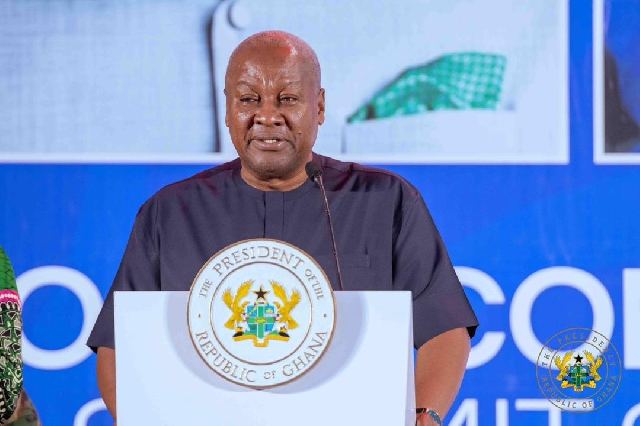 The Presidency (Pic):
President John Dramani Mahama has outlined an ambitious five-pillar strategy to strengthen local content and indigenisation in Ghana’s mining industry, calling for a decisive shift from raw mineral exports to value-added industrialisation.
Speaking at a two-day summit organised by the Minerals Commission on the theme “Strengthening Local Content and Indigenization: Building a Resilient Mining Sector in Ghana,” President Mahama said Ghana must move beyond being merely a leading producer of minerals to becoming a full participant across the extractive value chain.
For more than a century, mining has anchored Ghana’s economy, shaping fiscal revenues and national development. From Obuasi and Tarkwa to Bibiani, Nangodi and Awaso, and now the emerging lithium belts, mineral wealth has remained central to the country’s growth story.
However, President Mahama acknowledged a persistent gap. Despite being Africa’s leading gold producer and among the top six globally, much of the high-value activity in the mining value chain—advanced engineering, processing, equipment manufacturing, refining and technical services—continues to take place outside Ghana’s borders.
In 2023, the extractive sector generated nearly $6.6 billion in export revenues. Yet local participation in high-value segments remains limited, with domestic procurement accounting for only a fraction of total sectoral spending.
“We have been prolific producers,” the President said, “but we have not yet become full participants in the extractive value chain.”
Learning from Global Models
President Mahama pointed to international examples to underscore the urgency of reform. He noted that Botswana leveraged strategic partnerships to retain value and enhance citizen participation in its diamond sector, while Chile transformed its copper advantage into a mining technology ecosystem.
Similarly, Indonesia mandated domestic nickel processing, repositioning itself at the centre of the global electric vehicle battery supply chain.
“The lesson is clear,” he stated. “Smart, enforceable and forward-looking local content policies do not deter investment. They create sustainable competitiveness.”
The Five Strategic Pillars
The President outlined five key pillars that will guide government policy:
* From Procurement to Partnerships
Local content must evolve from transactional procurement to transformational partnerships. Government will review mining legislation and regulatory frameworks to help Ghanaian enterprises move up the value chain—from suppliers of consumables to manufacturers of critical components and innovators. Equity participation, technology transfer and knowledge sharing, he said, must become standard practice.
* End Raw Ore Exports
President Mahama announced plans to eliminate raw ore exports within five years. Government will support the establishment of refineries and bullion infrastructure, promote mineral-based industrial clusters, and facilitate downstream processing of bauxite, manganese and lithium to align with the global green energy transition.
“Our mineral wealth must power Ghana’s industrialisation, not merely sustain export dependence,” he emphasised.
* Skills and Workforce Development
A competitive mining sector requires a highly skilled workforce. The President pledged support for institutions such as the University of Mines and Technology and technical universities nationwide. Priority areas will include automation, robotics, drone and exploration technologies, data analytics, environmental sustainability and renewable energy integration.
“We must train not only miners, but mining technologists, engineers and innovators,” he said.
* Digital and Sustainable Mining
Positioning Ghana as a hub for AI-assisted exploration, IoT-enabled asset management and blockchain-based supply chain transparency forms the fourth pillar. Government will explore establishing a national mining innovation and research hub to promote local R&D and technology adaptation.
* Indigenous Participation and Ownership
The fifth pillar focuses on scaling up indigenous Ghanaian participation from subcontracting to full ownership of large-scale mining operations.
President Mahama cited the Black Volta Gold Project by Engineers and Planners Limited as a milestone—the first large-scale mining project undertaken by a wholly Ghanaian-owned company. When operational, it is expected to produce approximately 170,000 ounces of gold annually over a projected mine life exceeding 15 years.
Responsible and Community-Centred Mining
The President stressed that local content cannot be separated from responsible mining. Government is strengthening development agreements and community engagement under the revised Minerals and Mining Framework, with traditional authorities and local institutions playing key oversight roles.
He reaffirmed the administration’s commitment to combating illegal mining, formalising artisanal and small-scale mining, reclaiming degraded lands and restoring polluted water bodies.
A Shared National Pact
Calling for collective responsibility, President Mahama urged Ghanaian entrepreneurs to raise standards of quality and innovation, while assuring international investors of policy stability and long-term partnerships grounded in genuine collaboration.
“If we get this right,” he concluded, “our greatest export will not be raw gold, bauxite, manganese or lithium. It will be Ghanaian talent, Ghanaian technology, Ghanaian enterprise, and a resilient and competitive mining economy.”
The summit, he said, must deliver more than declarations—it must produce a binding national commitment to transform Ghana’s mining sector for generations to come.
Source: classfmonline.com/Pearl Ollennu


Trending News
President Mahama visits 2 survivors of Burkina Faso terrorist attack transferred to 37 Military Hospital
18:24
Muslims begin Ramadan fast today
03:22
GMTF Administrator highlights April rollout in television interview
12:22
Veteran broadcaster Dr. Abubakari Sidick Ahmed passes on at 63
15:53
UE/R: Police arrests suspect over murder of officer in Zebilla
17:09
Osei Kwame Despite laughs off alleged NACOC arrest links
12:40
Minority condemns government over cocoa price reduction
19:13
Hope arrives in Savannah as GMTF engages Bole Municipal Hospital
07:15
Ghana Boundary Commission erects international boundary pillars along Ghana–Côte d’Ivoire border
10:39
E/R: Police arrest 2 suspects over motorbike robbery at Sibakon Down
16:09
