
Kenyan MPs accuse British soldiers of sexual abuse and environmental destruction
World News
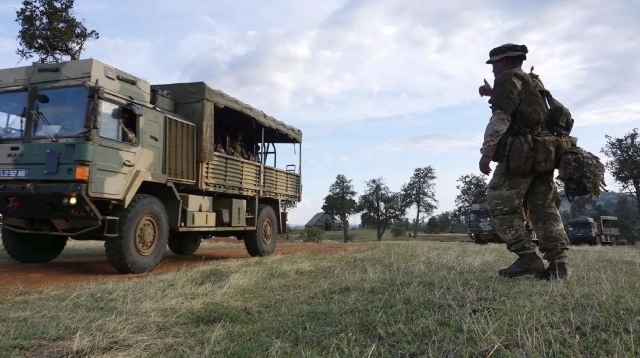 AFP via Getty Images (Pic): British troops have been training in central Kenya for decades under a military agreement
Kenya's parliament has accused British soldiers of decades of sexual abuse, killings, human rights violations and environmental destruction while training in the country.
The report detailed harrowing testimony from communities in Laikipia and Samburu counties, near the military training bases.
The British soldiers are accused of evading accountability by refusing to cooperate with the parliamentary investigation.
The UK High Commission in Kenya said it regretted that its submission was not reflected in the report's conclusions and affirmed its readiness to investigate the allegations "under our jurisdiction fully, once evidence is provided".
For decades, troops from the British Army Training Unit in Kenya (Batuk) have been training in central Kenya but their presence has long attracted controversy, with soldiers accused of misconduct and rights abuses.
More than 1,000 Kenyan soldiers receive British training each year, while thousands of UK troops are sent to Kenya for training exercises.
In a 94-page report following a two-year inquiry, Kenya's parliamentary Committee on Defence, Intelligence and Foreign Relations accused Batuk of continued ethical breaches, rights violations and environmental negligence, as well as employment and labour concerns.
The panel cited oral and written submissions from affected civilians, victims, community leaders, civil society organisations and public agencies.
The report said that during the inquiry, host communities had complained of killings, assaults and maimings, including public fights and fatal traffic incidents, involving Batuk soldiers.
The report said that Batuk was "increasingly seen as an occupying presence rather than a development partner, with affected residents drawing parallels to colonial injustices".
Among the worst cases was the 2012 murder of Agnes Wanjiru, whose body was found in a hotel septic tank in the central garrison town of Nanyuki, nearly three months after she was alleged to have spent an evening with British soldiers.
The panel said the "pursuit of justice has been slow and fraught with frustration".
"It was submitted that the process of investigation has faced undue interference and obstruction, allegedly by Batuk personnel, which continues to hinder the delivery of justice," it added.
A former British soldier accused of Wanjiru's murder was arrested last month after a warrant was issued in the UK and he now faces extradition to Kenya. He has denied the charge, and his lawyers said he intended to contest the extradition.
Another case was the "unlawful killing" of herder Tilam Leresh allegedly by a Batuk sergeant in 2012, "yet no arrest or prosecution has taken place in either Kenya or the UK".
The UK has previously expressed regret over Leresh's shooting by an on-duty British soldier, but in a statement to the parliamentary committee in October, the Ministry of Defence noted that British prosecutors had concluded there was insufficient evidence to bring charges. The UK said it remained open to considering any new evidence that might emerge.
The report also noted "disturbing trends of sexual misconduct by Batuk personnel" and claimed that survivors of sexual violence reported cases being dropped or mishandled by local authorities, with "many victims denied access to justice".
It cited "compelling evidence" of widespread sexual violence perpetrated by Batuk soldiers particularly against women from the Samburu and Maasai communities.
"Cases of rape and sexual violence by Batuk soldiers remain unresolved, and justice has not been served to the victims."
The report documented testimony from victims, detailing how British soldiers had allegedly preyed on local women, attacking them while they were fetching firewood, water, or grazing livestock.
It recounted a horrific 1997 incident in Archer's Post where "30 women were gang-raped at knife-point", some inside their own homes.
Batuk said it had "zero tolerance for sexual exploitation and abuse" and took any such allegations very seriously.
Witnesses also described instances of public indecency by soldiers, including exposing themselves in social venues and town centres, often involving intoxication, disorderly behaviour, and in some cases, violent or sexually aggressive conduct.
Besides rape and assault, the inquiry also documented cases of abandoned "fatherless" children.
"Dozens of children have been fathered by British soldiers who returned home, leaving behind single mothers facing stigma and financial hardship," it stated.
The MPs also alleged that Batuk has never carried out the legally required environmental and social impact assessments for its field exercises, and raised concerns over the possible use of white phosphorus, which they described as "notorious for the severity of the injuries it causes".
Residents reported respiratory issues, miscarriages, and livestock deaths due to toxic fumes and leftover military waste.
In one case, a ranger reportedly died after taking home unexploded ordnance from a Batuk range, while a child is said to have lost both arms and an eye after encountering another.
In its defence, Batuk said that independent environmental audits showed high levels of compliance with Kenyan regulations.
The investigating panel said Batuk had "persistently" declined to appear before the committee and instead "invoked claims of diplomatic immunity".
The British defence ministry said it had responded to the issues highlighted during the inquiry and "outlined the actions taken to address the concerns raised".
In a statement, the UK High Commission said it was prepared to investigate "where new allegations have come to light in the committee's report".
"We deeply regret the challenges which have arisen in relation to our defence presence in Kenya," it said.
But the parliamentary panel found the existing defence cooperation agreement between Kenya and the UK was "structurally flawed", saying the legal instrument has huge gaps.
It noted that "the offence of murder, despite its gravity, is not explicitly listed… as an offence deemed outside the course of official duty".
This, it argued, created a "significant obstacle to justice," adding that the existing oversight mechanism was largely ineffective.
The committee recommended the military agreement be amended to introduce a visiting forces code of conduct, zero-tolerance rules for gender-based violence, environmental obligations, and civilian oversight.
It also called on the Kenyan defence ministry to negotiate with the UK government on mechanisms to hold Batuk soldiers accountable for child support.
Source: bbc.com


Trending World

Zelensky's top adviser resigns after Ukrainian anti-corruption raid on his home
22:50
Guinea-Bissau president flees to Senegal after coup
10:42
Japan's same-sex marriage ban is constitutional, says Tokyo court
10:40
The kidnap gangs, jihadists and separatists wreaking havoc in Nigeria
10:38
Trump says US will 'permanently pause' migration from 'third world countries'
10:32
Relocation of Ukrainian children is humanitarian, not abduction- Russian Ambassador
09:18
Nigeria blames jihadist groups for wave of kidnappings but others accuse criminal gangs
00:44
Pope Leo visits Istanbul's Blue Mosque
00:37
Nigerian villagers 'too scared to speak' after hundreds of schoolchildren kidnapped
15:45
Australian prime minister becomes first to wed in office
14:55
