

GIPC boss outlines government’s key economic priorities for 2026
Business
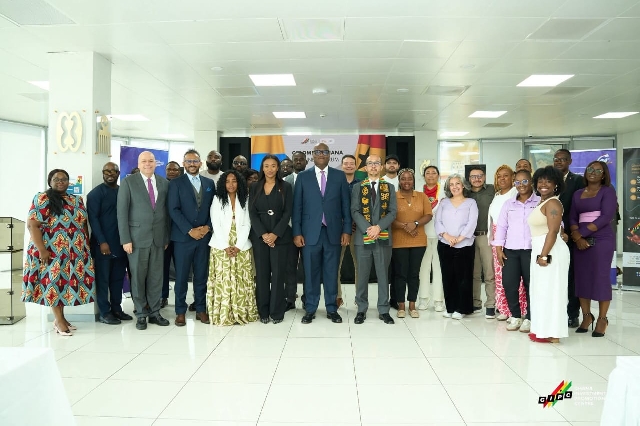 Mr Simon Madjie, in a group photo with Columbian Delegation
The Chief Executive Officer of the Ghana Investment Promotion Centre (GIPC), Mr Simon Madjie, has outlined the government’s key economic priorities for 2026, calling on investors and private sector players to position themselves to take advantage of emerging opportunities in infrastructure development, agriculture and value-chain expansion.
Speaking at an engagement with a Colombian business delegation in Accra, Mr Madjie said recent gains in macroeconomic stability had created a solid foundation for the implementation of a focused growth agenda aimed at tackling long-standing structural challenges in the economy.
The meeting was held on the sidelines of a state visit by Colombia’s Vice President, H.E. Francia Márquez.
Mr Madjie disclosed that infrastructure development would be a major driver of growth, with the government planning to invest nearly US$3 billion in the rehabilitation and construction of highways and road networks across the country.
He noted that the scale of the proposed projects would open up significant opportunities for construction firms, engineering companies and related industries, while improving national connectivity to support economic activity.
He also highlighted the 24-Hour Economy and Accelerated Export Development (24H+) policy as a central pillar of the government’s growth strategy, describing it as an accelerated development programme rather than a mere extension of working hours.
According to him, the initiative is designed to strengthen domestic production, enhance competitiveness and make the economy more self-sufficient.
Mr Madjie pointed out that Ghana currently spends about US$3 billion annually on food imports, stressing that government interventions are focused not only on increasing food production but also on strengthening the entire agricultural value chain, from production and processing to storage and distribution.
He said improved linkages between farms and processing centres would reduce post-harvest losses, increase value addition and create sustainable employment.
As part of the 24-hour economy agenda, the GIPC Chief Executive cited the Volta Economic Corridor programme, which aims to develop about two million hectares of land for year-round agricultural production.
The initiative, he explained, would leverage water resources around the Volta River to support irrigation, all-season farming and plantation agriculture.
Mr Madjie further revealed plans to develop approximately 200,000 hectares of new cocoa farmland within the corridor to boost output and export earnings.
He urged both local and foreign investors to partner with the government to capitalise on opportunities arising from the infrastructure drive and the 24-hour economy programme.
The Colombian business delegation was led by the Deputy Minister of Commerce, Mr Tito Rufino Yepes, who reaffirmed Colombia’s commitment to strengthening relations with Ghana.
He outlined the Colombia Strategy for Africa, a framework aimed at expanding diplomatic, economic and cultural engagement across the continent.
Mr Yepes emphasised the importance of South–South cooperation, shared historical ties—particularly with Afro-descendant communities—and Colombia’s intention to draw on its development and peacebuilding experience to deepen trade and strategic partnerships with Ghana and other African countries.
Source: Classfmonline.com/Cecil Mensah


Trending Business

IBAG reflects on a “mixed year” as industry records major wins
11:46
Domestic tourism spending hits GH₵6.59bn in 2023 - GSS
08:55
Bank of Ghana holds post-MPC engagement with bank CEOs after 127th meeting
03:53
Ghana's Cybele Energy makes history with offshore Guyana oil block deal
12:53
IBAG elects new executives at 12th general meeting
04:57
First Atlantic Bank PLC set for official listing on the Ghana Stock Exchange
12:46
SIC Managing Director James Agvenim-Boateng honoured by IBAG
05:34
IMF technical mission engages Ghana on implementing governance reforms
05:08
NPA hosts 2025 Downstream CEOs breakfast meeting to shape industry’s future
15:16
Ghana to establish Trade House in the UK to boost exports — High Commissioner reveals
15:05