

INTERCEM Africa 2026: Trade Minister urges cement firms to use local raw materials
Business
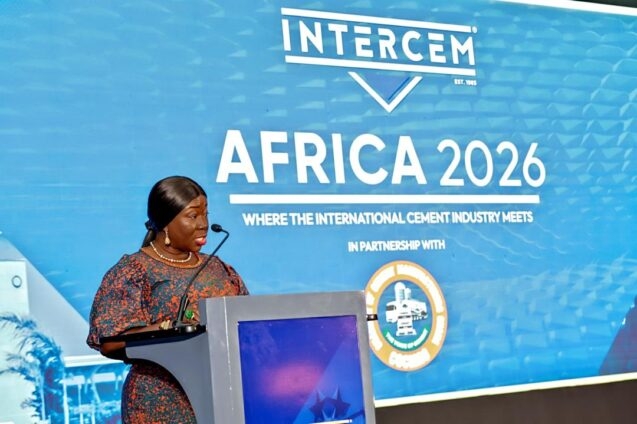 The Minister for Trade, Agribusiness and Industry, Elizabeth Ofosu-Adjare, at Intercem Africa 2026
The Minister for Trade, Agribusiness and Industry, Elizabeth Ofosu-Adjare, has urged cement manufacturers in Ghana to increase the use of locally available raw materials to reduce reliance on imported clinker and promote sustainable cement production.
Speaking at INTERCEM Africa 2026 in Accra, the minister said innovation was critical to the future of Ghana’s cement industry, stressing the need to develop cost-effective production systems that make better use of the country’s natural resources.
She highlighted advancements in Limestone Calcined Clay Cement (LC3), citing the efforts of CBI Ghana and Ghacem as examples of how the industry can reduce clinker consumption while maintaining production efficiency.
The minister noted that Ghana’s industrialisation drive would continue to increase demand for cement, making it necessary to adopt environmentally sustainable production methods and strengthen import substitution efforts.
INTERCEM Africa 2026, organised in partnership with the Chamber of Cement Manufacturers, Ghana (COCMAG), brought together delegates from about 40 countries and more than 100 companies to discuss the future of cement production.
Chairman of COCMAG and Chief Executive Officer of CBI Ghana, Frederic Albrecht, said Ghana remains heavily dependent on imported clinker because the country lacks suitable limestone deposits for clinker production.
According to him, rising fuel prices, port congestion and global supply chain disruptions have increased the cost of clinker imports, making the use of alternative local materials essential for the industry’s sustainability and competitiveness.
He said products developed with reduced clinker content demonstrate how Ghana can leverage local resources to lower production costs and improve efficiency.
Chief Executive Officer of COCMAG, Bishop Dr George Dawson-Ahmoah, said the conference was aimed at promoting a sustainable cement industry capable of supporting economic growth through environmentally friendly production methods.
He noted that Ghana is gradually reducing its dependence on clinker through the use of clay and other local materials, describing the shift as an important step towards more sustainable and cost-effective cement production.
The conference featured discussions on LC3 technology, global cement market trends, net-zero transition strategies, shipping and port challenges in West Africa, and developments in global clinker supply.
Source: classfmonline.com


Trending Business

Government Treasury Bills oversubscribed by 13.61% amid rising interest rates
20:46
Fuel prices set to drop nationwide from June 16
20:42
Ghana’s new investment law to reduce bureaucracy, strengthen investor confidence – GIPC CEO
20:11
COCOBOD CEO calls for greater trust and unity in Ghana-Cote d'Ivoire cocoa partnership
17:21
Adamus CEO Angela List elected 1st Vice President of Ghana Chamber of Mines
16:13
GLOA confirms the market dominance of KGL, urges stakeholders not to compare GLOA's GHS44.9m to KGL's GHS173m to NLA
07:26
Bank of Ghana extends IMTO registration deadline to July 31
19:25
Ghana courts Canadian investment in upstream oil and gas sector
04:27Bank of Ghana orders financial institutions to freeze support for unauthorised crypto forex wallets
04:09
Ghana Stock Exchange hits massive growth in May 2026 as trading activity surges
03:27
