

National Security arrests traders over sale of dangerous ‘Madala’ chemical in Kumasi
Crime
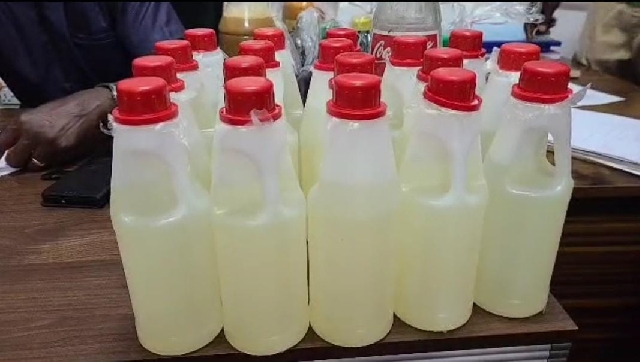 The seized substance
National security operatives in the Ashanti Region have arrested four traders for allegedly dealing in an unapproved and hazardous chemical substance known as “Madala,” which is falsely advertised as a drink capable of “cleaning the heart.”
The arrests were made on Thursday, February 27, 2026, at the French Line of the Kumasi Central Market near Aboabo Station in the Kumasi Metropolis.
According to the Regional Deputy National Security Coordinator, Alhaji Nje Abdallah Umaru, the operation was carried out following intelligence reports that the substance was being sold in the market and supplied by Nigerien dealers.
Speaking to Kumasi-based radio station, Kumasi FM, Alhaji Nje disclosed that security operatives tested a sample of the chemical by pouring it into a plastic takeaway bowl, which melted instantly — raising immediate concerns about its corrosive properties.
Subsequently, samples were sent to the Department of Pharmacology at the Kwame Nkrumah University of Science and Technology (KNUST) for laboratory analysis to determine their composition and potential health risks.
He revealed that laboratory tests showed that within 48 hours of administering the substance to mice, the animals died, confirming the chemical’s highly dangerous nature and the severe health risks it poses to humans if consumed.
The operation was conducted under the directive of the Ashanti Regional National Security Coordinator, Captain (Rtd) Kwame Jabari.
The suspects — comprising one male and two females — are currently in National Security custody as investigations continue.
Authorities have also intensified efforts to raid the market to remove the harmful substance from circulation.
Alhaji Nje cautioned the public against purchasing or consuming such products, urging vigilance and warning that the chemical poses a serious threat to human health.
He indicated that public education campaigns would be rolled out to raise awareness and prevent further exposure.
He also expressed disappointment with the Food and Drugs Authority (FDA), stating that although a sample had earlier been submitted to the Authority for testing, results had not been received after nearly two months of follow-up.
Alhaji Nje, however, commended the Pharmacology Department at KNUST for its swift and decisive response in analysing the substance and confirming its dangers.
Source: Classfmonline.com/Elisha Adarwah


Trending News

Two Salaga midwives granted GH¢150k bail in missing baby case
13:50
NE/R: Free Primary Healthcare launched
14:35
A/R: 2 jailed over armed robbery at New Edubiase fuel station
05:43
Court annuls GTEC directive barring UNEM degrees, cites breach of due process
03:58
President Mahama calls for stronger trade and investment ties at Ghana–EU partnership dialogue
03:21
Ablakwa calls for global action on reparatory justice
13:44
National College of Defence Studies conducts research on national cohesion in Volta Region
14:27
Police arrest suspect in murder of UCC student
05:37
Suspected armed robber dies with gunshot wound after taxi hijacking and crash in Accra
03:45
GRA honours staff who completed leadership development programmes
03:02