

US still believes Iran has not decided to build a nuclear weapon, US officials say
World News
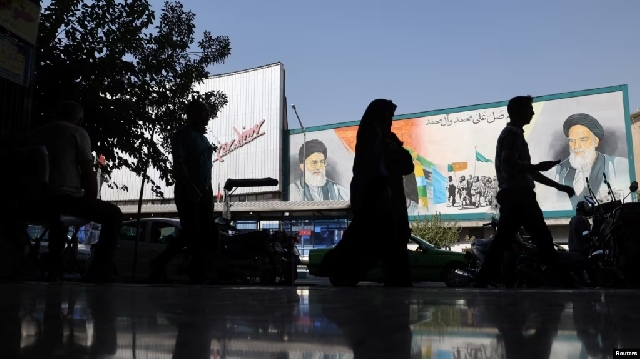 Majid Asgaripour/WANA via Reuters (Pic): People walk past a mural depicting the late leader of the Islamic Revolution Ayatollah Ruhollah Khomeini and Iran's Supreme Leader Ayatollah Ali Khamenei on a building in a street in Tehran, Iran, Oct 7, 2024
The United States still believes that Iran has not decided to build a nuclear weapon despite Tehran's recent strategic setbacks, including Israel's killing of Hezbollah leaders and two largely unsuccessful attempts to attack Israel, two U.S. officials told Reuters.
The comments from a senior Biden administration official and a spokesperson for the Office of the Director of National Intelligence (ODNI) added to public remarks earlier this week by CIA Director William Burns, who said the United States had not seen any evidence Iran's leader had reversed his 2003 decision to suspend the weaponization program.
"We assess that the Supreme Leader has not made a decision to resume the nuclear weapons program that Iran suspended in 2003," said the ODNI spokesperson, referring to Iran's leader Ayatollah Ali Khamenei.
The intelligence assessment could help explain U.S. opposition to any Israeli strike on Iran's nuclear program in retaliation for a ballistic missile attack that Tehran carried out last week.
U.S. President Joe Biden said after that attack he would not support an Israeli strike on Iranian nuclear sites, but did not explain why he had reached that conclusion. His remarks drew fierce criticism from Republicans, including former President Donald Trump.
U.S. officials have long acknowledged that an attempt to destroy Iran's nuclear weapons program might only delay the country's efforts to develop a nuclear bomb and could even strengthen Tehran's resolve to do so.
"We're all watching this space very carefully," the Biden administration official said.
Iran's mission to the United Nations in New York did not immediately respond to a request for comment but Tehran has repeatedly denied ever having had a nuclear weapons program.
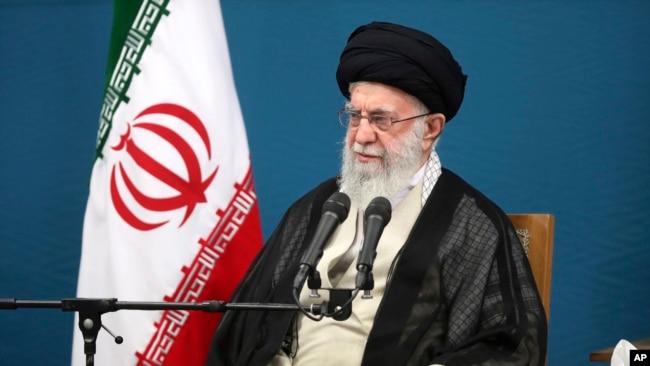 | Office of the Iranian Supreme Leader via AP (Pic): Iranian Supreme Leader Ayatollah Ali Khamenei attends a meeting with members of President Masoud Pezeshkian's administration, in Tehran, Iran, Aug. 27, 2024
Key Iran ally weakened
In the past weeks, Israel's military has inflicted heavy losses on Hezbollah, the most powerful member of the Iran-backed network known as the Axis of Resistance. The group's setbacks have included the killing of its leader Hassan Nasrallah in an Israeli airstrike last month.
The weakening of a key Iranian ally has prompted some experts to speculate that Tehran may restart its efforts to acquire a nuclear bomb to protect itself.
Beth Sanner, a former U.S deputy director of national intelligence, said the risk of Khamenei reversing his 2003 religious dictum against nuclear weapons is "higher now than it has been" and that if Israel were to strike nuclear facilities Tehran would likely move ahead with building a nuclear weapon.
That would still take time, however.
"They can't get a weapon in a day. It will take months and months and months," said Sanner, now a fellow with the German Marshall Fund.
Iran is now enriching uranium to up to 60% fissile purity, close to the 90% of weapons grade, at two sites, and in theory it has enough material enriched to that level, if enriched further, for almost four bombs, according to a yardstick of the International Atomic Energy Agency (IAEA), the U.N. watchdog.
The expansion in Iran's enrichment program has reduced the so-called breakout time it would need to produce enough weapons-grade uranium for a nuclear bomb to "a week or a little more," according to Burns, from more than a year under a 2015 accord that Trump pulled out of when president. Actually making a bomb with that material would take longer. How long is less clear and the subject of debate.
Possible Israeli attack
Israel has not yet disclosed what it will target in retaliation for Iran's attack last week with more than 180 ballistic missiles, which largely failed thanks to interceptions by Israeli air defenses as well as by the U.S. military.
The United States has been privately urging Israel to calibrate its response to avoid triggering a broader war in the Middle East, officials say, with Biden publicly voicing his opposition to a nuclear attack and concerns about a strike on Iran's energy infrastructure.
Israel, however, views Iran's nuclear program as an existential threat.
The conflicts in the Middle East between Israel and Iran and Iran-backed groups in Lebanon, Gaza and Yemen have become campaign issues ahead of the November 5 presidential election, with Trump and his Democratic rival, Vice President Kamala Harris, positioning themselves as pro-Israel.
Speaking at a campaign event last week, Trump mocked Biden for opposing an attack on Iran's nuclear sites, saying: "That's the thing you wanna hit, right?"
Avi Melamed, a former Israeli intelligence officer and government official, said Iran still had space to compensate for setbacks dealt to its proxies and missile force without having to resort to developing a nuclear warhead.
"The Iranians have to recalculate what's next. I don't think at this point they will rush to either develop or boost the (nuclear) program toward military capacity," he said.
"They will look around to find what maneuvering space they can move around in."
Source: reuters.com


Trending World

Bangladesh's first female prime minister Khaleda Zia dies aged 80
22:38
Thieves use drill to steal €30m in German bank heist
22:35
Guinea junta chief takes lead in controversial election as social media restricted
22:30
Living in fear of Lakurawa - the militant group Trump targeted in Nigeria strikes
19:31
US pledges $2bn for humanitarian aid, but tells UN 'adapt or die'
19:21
9 arrested in Italy for allegedly raising millions for Hamas
00:08
Israel recognises Somaliland as independent state, Netanyahu says
01:42
US launches strikes against Islamic State in Nigeria
01:38
UN experts urge Iran to stop execution of woman activist
17:30
US economy grows at fastest pace in two years
18:28