
From revolution to republic: Akwasi Opong-Fosu declares the Rawlings headquarters constitutional covenant, not historical decor
Feature Article
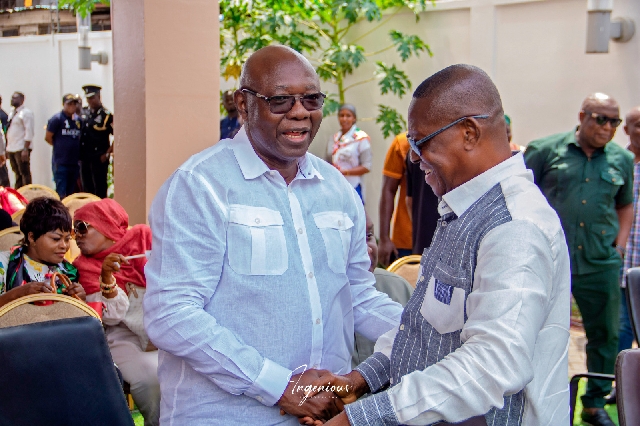 Akwasi Opong-Fosu (L)
The foundational pillars of Ghana’s democratic journey took center stage on Monday, June 22, 2026, as statesmen, political leaders, and cadres gathered to commemorate the 79th birthday of the late former President and founder of the National Democratic Congress (NDC), Flt Lt Jerry John Rawlings.
Organised jointly by the NDC and the J.J. Rawlings Foundation, the memorial events highlighted a profound historical transition under the theme “From Revolution to Fourth Republic: The Rawlings Legacy”.
The day’s observances began with an emotional morning ceremony where the NDC national headquarters in Accra was officially named after Rawlings, alongside the unveiling of a commemorative bust by party leader and President John Dramani Mahama.
Later in the afternoon, the discourse shifted to the auditorium of the Ghana Academy of Arts and Sciences, where leading national figures gathered for a high-profile lecture and exhibition.
Delivering a powerful address alongside keynote speaker and legal luminary Tsatsu Tsikata, as well as former National Security Minister Kofi Totobi Quakyi, the Board Chairman of the Ghana Investment Promotion Centre (GIPC), Akwasi Opong-Fosu, centered his remarks on a definitive topic: "Probity Has An Address: What the Rawlings House Demands From Us." In a comprehensive, sweeping assessment of the state of the republic, the former Minister for Local Government mapped out an urgent blueprint for the nation's future, linking the structural evolution of the state directly to the ethical obligations inside the newly Christened party headquarters.
A Mandate for Structural Reforms and Institutional Spirit
Akwasi Opong-Fosu asserted that the true value of Jerry John Rawlings’ legacy lies not in historical nostalgia, but in its power to serve as a driving force for ongoing structural changes within Ghana's public sector. He stated clearly that the survival of the Fourth Republic relies heavily on the state's willingness to execute sustained, deliberate reforms aimed at strengthening public accountability and reinforcing state institutions.
Reflecting on the historic transition, Opong-Fosu noted that Rawlings achieved his crowning institutional milestone by ditching the gun for the constitution, moving the nation from rule by decrees to the rule of law. However, the GIPC Chair highlighted a critical modern tension: while Ghana successfully institutionalised democratic structures and elections every four years, it failed to institutionalize the internal spirit and conscience required to sustain them. He argued that the legacy is incomplete without adding a third leg to the transition — moving from a Republic to an era of absolute individual and institutional responsibility.
Bridging Socio-Economic Inequality and Honoring the Base
Shifting his focus to the social health of the country, Opong-Fosu delivered a blunt warning regarding the expansion of economic disparities, noting that widening wealth gaps risk undermining the democratic gains achieved over the past three decades. He reminded the audience that Flt Lt Jerry John Rawlings dedicated his entire political life to championing the cause of ordinary, marginalized, and vulnerable citizens.
Hon. Opong-Fosu maintained that honoring that sacrifice requires modern leaders to take immediate, aggressive steps to address the socio-economic inequality gripping the country. He tied this directly to internal party operations, stressing that the local polling station and branch executives must feel the tangible presence and support of the party long before wealthy individuals who do not share the movement's core values are allowed to buy influence. True democratic consolidation, he argued, cannot be achieved while the grassroots feel entirely excluded from national economic progress and localized decision-making.
The Headquarters Naming: A Covenant of Conduct, Not Architecture
In his final and most urgent charge, Opong-Fosu linked the significance of the newly named NDC Headquarters to an unyielding covenant of personal and political conduct. He warned that if the name on the wall is treated as mere concrete décor or political performance, it violates the very memory of a leader who famously signed the party's manifesto in his own blood.
The GIPC Board Chairman stated that the letters on the building must act as a daily moral mirror for every Member of Parliament, National Executive Committee member, and party operative entering its doors. If monetisation remains the gatekeeper for leadership selection, if big men receive immunity while ordinary members face strict sanctions, then the naming is exposed as hollow theatre.
Opong-Fosu concluded by reminding the audience that Rawlings' historic warning—that the greatest threat to the NDC is the conduct of the NDC itself—must be answered with a transformation of behavior. To truly preserve the legacy, the contemporary political class must move past simply remembering Rawlings, and instead demonstrate the integrity, institutional discipline, and social justice required to "become" Rawlings in practice.
Source: classfmonline.com


Trending Features

Why smart people fall for online scams: 3 psychological tricks cybercriminals use
13:27
When your job title or qualification disappears, who still remembers you?
12:30
From revolution to republic: Akwasi Opong-Fosu declares the Rawlings headquarters constitutional covenant, not historical decor
05:13