
President Mahama’s agro-industrial revolution: Turning Ghanaian farms into business powerhouses
Feature Article
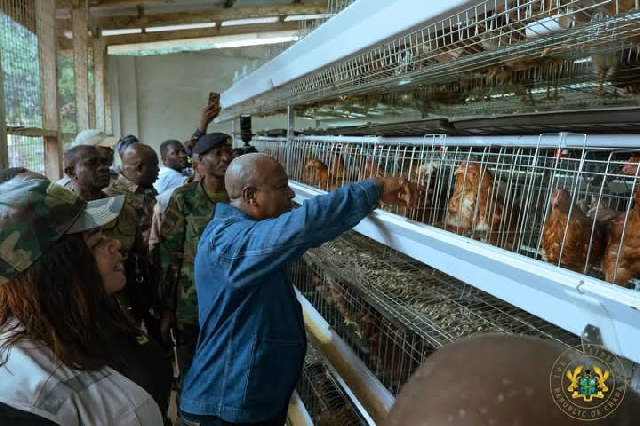 President John Mahama
The government’s push for agro-industrialisation is reshaping Ghana’s agricultural landscape, with new processing plants for rice, poultry feed, cashew, and onions creating jobs, strengthening rural economies, and opening lucrative markets for farmers.
Under President John Dramani Mahama, agriculture is no longer viewed as subsistence work; it is being strategically repositioned as a competitive business sector capable of powering exports, accelerating industrial growth, and driving national development.
This bold shift is unlocking value along the entire agricultural chain, transforming primary production into profitable enterprises and establishing Ghana as an emerging agro-industrial force in the region.
At the Government Accountability Series, where the Minister for Food and Agriculture and Asunafo South Member of Parliament, Mr Eric Opoku, highlighted the government’s achievements, a clear picture emerged of an agricultural sector in rapid transition.
His presentation underscored how targeted investments in manufacturing, irrigation, infrastructure, and technology are building an economy where farmers are linked to reliable markets and modern processing facilities that multiply the value of their produce.
Agro-processing hubs boost jobs and rural growth
Across Ghana, strategic agro-processing projects are redefining how crops move from farms to markets.
In Tono, Chiragia Farms Limited is installing USD 23,000 worth of advanced rice processing machinery that will provide dependable market access for rice farmers in Tono and the North East Region.
This investment ensures improved quality, reduced post-harvest losses, and higher incomes for farmers.
In the Ashanti Region, A2 Agro Allied Company is building a modern poultry feed processing facility in Kaase, strengthening a key segment of Ghana’s poultry value chain and supporting thousands of small and commercial poultry farmers.
Techiman is also emerging as a major agro-industrial hub, where Nadkansco Processing Limited and Obapack Company Limited are establishing cashew and onion processing facilities to stimulate job creation and boost the value of local raw materials.
On a larger scale, Almansour Holding’s entry into Ghana marks a historic milestone.
The multinational is investing USD 3.5 billion in a fertiliser production plant and a fertiliser academy, along with USD 1.5 billion for year-round food production targeted at exports to Qatar.
This creates new market channels for Ghanaian farmers and deepens the integration of local agriculture into global value chains.
Global partnerships modernise Ghanaian farming
Ghana’s agricultural modernisation is being accelerated by transformative global partnerships. A €154 million investment from the Government of Italy, in collaboration with BF International, will establish a 10,000-hectare irrigated model farm dedicated to producing rice, maize, soya, and tomato on a year-round basis.
This farm will operate as a commercial-scale demonstration of modern irrigation, mechanisation, and high-yield crop production.
Critical components of this initiative include a partnership with CIHEAM Bari to establish a national seed bank in collaboration with the West Africa Centre for Crop Improvement (WACCI) and a comprehensive soil testing and suitability programme to be implemented with the Council for Scientific and Industrial Research (CSIR).
These interventions lay the scientific foundation for sustained production efficiency, crop resilience, and genetic improvement.
Another strategic partnership with the Korea Rural Cooperation (KRC) is supporting irrigation development on 100 hectares of land for rice seed production.
By 2027, Ghana is projected to produce 10,000 tons of high-quality rice seed, ushering the country toward rice seed independence and improved national food security.
Food inflation falls as local production rises
One of the most significant outcomes of the government’s agricultural interventions is the dramatic reduction in food inflation. From an alarming high of 61% in January 2023, food inflation fell to 28.3% in January 2025 and sharply declined further to 9.5% by October 2025.
This stability reflects improved local production, expanded irrigation, enhanced access to inputs, and growing capacity in agro-processing that helps maintain steady food supplies year-round.
Feed Ghana programme transforms rural communities
The Feed Ghana Programme has become a cornerstone of rural economic transformation.
Within nine months, the government has constructed 10 new small dams, rehabilitated eight others, and installed 250 solar-powered boreholes across farming communities and second-cycle schools in the northern, Bono, and Ahafo regions.
These efforts ensure water availability throughout the year, enabling farmers to cultivate crops during both rainy and dry seasons.
Extensive rehabilitation works on major irrigation schemes—Vea, Weta, Tanoso, Kpong, Ashaiman, and Aveyime—cover thousands of hectares and significantly expand Ghana’s irrigated farming capacity. In addition, new inland valley developments across Ashanti and Bono East regions are unlocking more than 1,200 hectares for year-round rice production, advancing Ghana’s position as a self-sustaining agricultural nation.
Scientific innovation strengthens crop yields
Through investments in agro-processing, irrigation infrastructure, scientific research, and global partnerships, President Mahama’s administration is building a modern agricultural economy that generates wealth, strengthens rural livelihoods, and expands opportunities for agribusiness.
Agriculture is now a driver of innovation, job creation, and export growth, placing Ghana firmly on the path toward economic transformation.
The country’s agro-industrial revolution is not just improving food production—it is reshaping the economic future of the nation.
With sustained investment and visionary leadership, Ghana’s agriculture sector is poised to become one of the most vibrant, competitive, and prosperous on the African continent.
- Raphael Apetorgbor (Communications Specialist and Policy Analyst)
Source: Classfmonline.com


Trending Features
President Mahama’s agro-industrial revolution: Turning Ghanaian farms into business powerhouses
12:19
Laud Nartey: Growing unethical behaviour among bank staff- why BoG, GAB must scale up surveillance
07:02
When the intellectual community abdicates responsibility, the consequences are dire
16:25
Why are Ghanaian girls still forced to cut their hair? A colonial practice Ghana must re-examine
12:16
The economics of cutting Ghanaian girls’ hair: How a colonial school rule became a modern financial trap
12:08
Has the credibility of KGL turned Fourth Estate and Media Foundation For West Africa into bitter liars?
01:14
Economic witch-hunting: Ghana’s silent betrayal of its builders, the story of Alex Apau Dadey—the visionary who dared to build beyond politics
09:32
Stop letting Maths and Science decide Ghana’s future
13:56