

BoG launches National Virtual Asset Literacy initiative as crypto law takes effect
Business
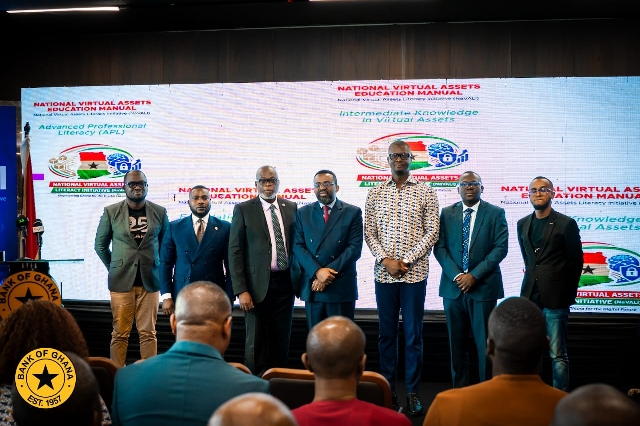 BoG boss at the launch in Accra
The Bank of Ghana on Friday launched a nationwide public education programme on virtual assets, signalling a cautious but forward-looking approach to regulating cryptocurrencies and related digital technologies following the passage of new legislation.
The National Virtual Asset Literacy Initiative (NaVALI), unveiled by Bank of Ghana Governor Johnson Pandit Asiama in Accra, is designed to improve public understanding of virtual assets and strengthen institutional capacity as the country prepares to operationalise its new regulatory framework.
The initiative comes after the enactment of the Virtual Asset Service Providers Act, which establishes a legal basis for regulating cryptocurrency exchanges and other virtual asset businesses.
The law designates the Bank of Ghana and the Securities and Exchange Commission (SEC) as the primary regulators.
Speaking at the launch, Asiama said regulators were now focused on building the systems and processes needed to implement the law in an “orderly and timely” manner, while addressing gaps and risks associated with the fast-growing digital asset sector.
“Effective regulation and enforcement cannot be achieved by regulators alone,” he said.
“The entire ecosystem must be adequately prepared through a sound understanding of virtual asset activities, their implications, and associated risks.”
Virtual assets, including cryptocurrencies, have gained popularity in Ghana in recent years, driven by high mobile phone penetration, a young population and growing interest in digital finance.
However, authorities have repeatedly warned of fraud, volatility and consumer protection risks linked to unregulated platforms.
Asiama said NaVALI was intended to address these concerns by placing education at the centre of Ghana’s digital finance strategy.
The initiative is built around the principle of “understand before you undertake”, positioning literacy as a prerequisite for safe participation in the digital economy.
The programme is being led by the central bank in collaboration with the SEC, alongside academic institutions and industry partners.
According to the governor, it pursues two main policy objectives: strengthening institutional capacity to regulate virtual assets and their underlying technologies, particularly blockchain, and promoting nationwide awareness of the risks and implications of virtual asset use.
He said building expertise within regulatory agencies would support effective supervision and policy formulation, while public education would help discourage uninformed and risky adoption by consumers.
On behalf of the Bank of Ghana and its partners, Asiamah formally launched the initiative, describing it as a foundational step toward a resilient and well-informed virtual asset ecosystem.
He also called for sustained collaboration among regulators, industry players, educators, civil society groups and the media, noting that successful implementation would depend on shared responsibility across sectors.
“The launch of NaVALI is not an end, but a beginning,” he said.
“It is the foundation upon which effective regulation, consumer protection and sustainable innovation in virtual assets will be built.”
Addressing the public, the governor urged Ghanaians to engage with the initiative by learning about virtual assets, asking questions and participating responsibly.
“Financial innovation can only serve national development when it is anchored in knowledge, trust and accountability,” he said.
Ghana’s move mirrors broader efforts across Africa to bring virtual assets under regulatory oversight while balancing innovation with financial stability.
Several African central banks have stepped up warnings about cryptocurrency risks even as adoption continues to rise.
Authorities say NaVALI will support Ghana’s broader digitalisation agenda by equipping both institutions and consumers with the tools needed to navigate emerging technologies safely.
Asiama said the initiative would help ensure that innovation in virtual assets contributes to inclusive growth rather than exposing citizens to avoidable financial harm.


Trending Business

2026 will test Ghana’s policy discipline despite improved indicators — BoG Governor
15:17
Startups: Seidu Agongo advises starting small with high-demand businesses like sachet water
11:42
BoG launches National Virtual Asset Literacy initiative as crypto law takes effect
10:44
Concerned Importers threaten to storm Jubilee House over alleged vehicle age manipulation at ports
09:30
Ghanaian delegation visits Port of Philadelphia to deepen trade and maritime cooperation with U.S.
06:45
Goldbod Jewellery and CavemanWatches explore partnership for global standard gold watch production
11:31
Regularise your practice: CIMG calls on marketing practitioners to comply with the law
19:00
NEIP governing board meets as Youth Minister pushes business acceleration agenda
18:09
HOTWAVE pays courtesy visit to Ga Mantse
06:47
Chief of Staff pledges stronger gov't–industry collaboration at AGI's investiture
05:43