

Biometric verification rule: How will the ban on Ghana Card photocopying affect photocopy operators?
Feature Article
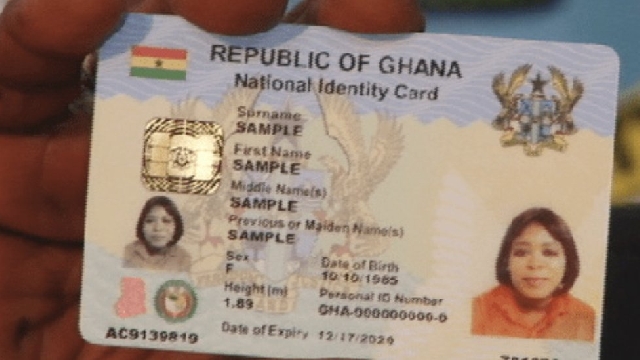 Ghana Card
The government's decision to make biometric verification mandatory for transactions involving the Ghana Card has raised questions about the future of businesses that depend on photocopying identity cards as part of their daily operations.
Under the new regulations, institutions are prohibited from using photocopies or visual inspection of the Ghana Card for identity verification. Instead, businesses and service providers are expected to use the National Identification Authority's biometric verification system to authenticate customers.
While the move has been widely praised as a major step towards tackling identity fraud and protecting personal data, photocopy operators fear the policy could reduce an important source of income.
For many operators, especially those located near banks, telecommunications outlets, passport offices and government institutions, photocopying Ghana Cards for account opening, SIM registration, job applications and other transactions has become a regular part of business.
Some operators worry that the shift to digital verification systems could lead to a decline in customer numbers and earnings, particularly for small businesses already struggling with rising operating costs and increasing competition from digital services.
Others, however, believe the impact may not be severe. They point out that photocopy centres provide several other services including printing, scanning, internet access, document typing, lamination and passport photography, which are likely to continue attracting customers.
Industry observers also argue that the new rules may create opportunities for some operators to diversify their businesses by investing in digital identity verification services, online registrations and other technology-driven solutions.
The National Identification Authority maintains that photocopying and visual inspection of the Ghana Card are vulnerable to fraud and impersonation, making biometric authentication the safest and most reliable means of identity verification.
As Ghana moves towards a fully digital identification system, the challenge will be balancing improved security with the livelihoods of thousands of small business operators whose incomes may be affected by the transition.
"Will the move to biometric verification strengthen security at the expense of jobs in the informal sector, or will it push businesses to innovate and adapt?"


Trending Features

The real crisis isn't the pitch — It's the neglect of Ghana's sports infrastructure
22:10
The human voice in the machine age: Preserving editorial judgment in an automated world
20:43
Journalism beyond the headline: Reclaiming depth in a surface-level media culture
17:37
Act 1159: Ghana's Blueprint for a Sustainable Sporting Future
16:14
Explainer: How the Dennis 'Miracles' Aboagye controversy unfolded
11:44
Messi vs Ronaldo: Has the GOAT debate finally been settled — or is this football's greatest illusion?
12:13
Biometric verification rule: How will the ban on Ghana Card photocopying affect photocopy operators?
12:08