

Ghana and World Gold Council forge partnership to curb illegal mining
News
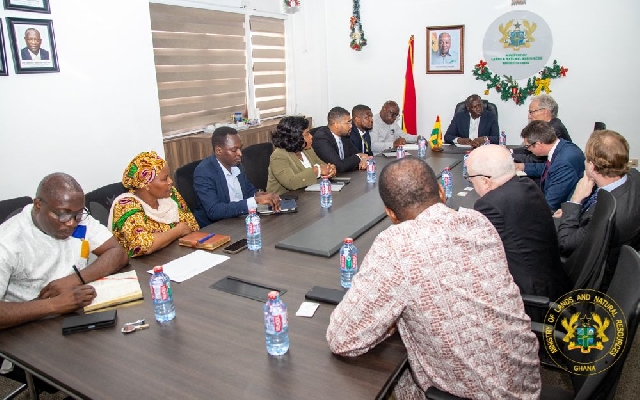 Lands Minister addressing the group
In a significant step towards sustainable mining to secure the future of Ghana's gold sector, the Ministry of Lands and Natural Resources has entered a transformative partnership with the World Gold Council (WGC) — the global authority on gold — which brings international expertise and market access to the table.
This strategic alliance is poised to decisively tackle illegal mining by creating a first-of-its-kind, fully traceable gold supply chain, anchored by the establishment of new, regulated community processing plants under the Responsible Cooperative Mining and Skills Development Programme (rCOMSDEP).
At a high-level engagement with the World Gold Council (WGC) on Monday,5th January 2026, the Minister for Lands and Natural Resources, Mr. Emmanuel Armah-Kofi Buah(MP), said the initiative fits squarely into the government’s broader strategy to formalise artisanal and small-scale mining (ASM), promote responsible mining, eliminate illegal mining (galamsey), and enhance the value of Ghana’s mineral resources.
Welcoming the WGC delegation, the Minister described the discussions as strategic and timely, noting they build on earlier talks held at the Mining in Motion Summit in 2025.
By channelling gold through these transparent points, the initiative directly tackles the informal and often illicit trade that has long challenged the sector.
CEO of the World Gold Council, David Tait, noted that Ghana’s rCOMSDEP initiative is a robust and well-thought-through model that can be a blueprint for formalising ASM across the world.
He intimated the WGC’s interest in the programme because it answers the nagging questions of the Council to identify sustainable supply chains that streamline and standardise gold sourcing from traceable and responsible sources to feed international refineries.
They also envisage that through their partnership, the sub-sector will be attractive enough for investors.
At the heart of the agreement is the creation of an integrated gold value chain built on three pillars: traceability from mine to market, centralised processing plants to aggregate and monitor gold, and the use of official buying channels.
Both parties agreed on an actionable roadmap, including the formation of a joint working team to ensure transparency in the rollout of the programme.
The goal is to have the first plants operational within six months of funding confirmation.
Source: Classfmonline.com/Samuel Payitey


Trending News

Inside Ken Ofori Atta's detention centre in US
08:49
Chwinto: Over 400 children benefit from Hope in sight Foundation's annual 'MAKE A CHILD SMILE'
09:29
Otumfuo pays historic visit to IGP today
07:05
Fiifi Kwetey’s ‘sycophancy’ in Mahama's third term could divide NDC- GFL Secretary General warns
21:59
3 suspects linked to robberies in Afienya and surrounding communities arrested, firearms recovered
12:32
Gov't scrutinising CRC report, no white paper will be issued-Haruna Iddrissu
02:04
COPEC calls for talks on transport fares after fuel price declines
08:07
NPA CEO visits Sentuo Refinery, commends role in downstream sector
03:46
Police take over Immigration Officer in 2,600 AK-47 ammunition trafficking probe
20:26
‘Make those who swallowed our riches vomit it’ – Agyinasare charges Mahama gov’t, says ‘not many’ve been tried, jailed yet’
11:16
