
Over 300 businesses now running under 24-Hour Economy programme – Secretariat
News
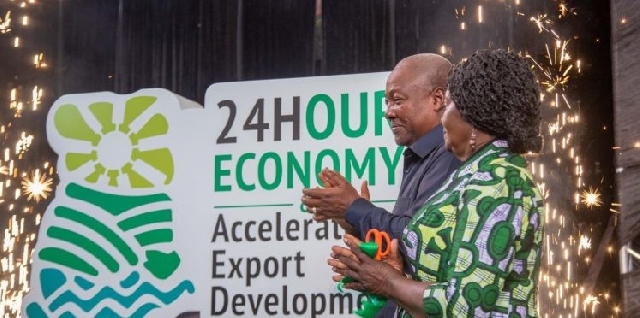 President John Mahama and Vice President Prof. Naana Jane Agyemang
The Secretariat of the 24-Hour Economy programme has dismissed claims that the government's flagship policy has failed to produce tangible results, insisting that implementation is already underway with billions of dollars in investment commitments, expanded 24-hour services and increased industrial activity.
In a statement responding to comments by the Ranking Member of Parliament's Economy and Development Committee, Kojo Oppong Nkrumah, the Secretariat said the programme has progressed beyond the planning stage and is already attracting significant private-sector participation.
According to the Secretariat, Joint Development Agreements valued at $5.5 billion had been secured with co-development partners as of May 2026. It added that 268 fuel stations and 33 manufacturing companies are already operating under the programme's multi-shift production model.
The response follows remarks by Mr. Oppong Nkrumah, who questioned the achievements of the initiative since its launch and suggested that substantial public resources had been committed without visible outcomes.
Rejecting that assertion, the Secretariat argued that the programme should be assessed based on the volume of investments mobilised, production capacity created, export potential and employment opportunities generated rather than government expenditure.
It disclosed that the initiative aims to create 1.7 million decent jobs by the end of 2028, adding that four investment agreements signed within the last three months alone are expected to generate more than 160,000 direct jobs.
The Secretariat also refuted claims that the programme had utilised part of the GH¢650 billion approved by Parliament over the past two years, explaining that the figure represents the country's overall national budget and not spending on the 24-Hour Economy policy.
It maintained that the programme is largely driven by private investment, with Ghanaian and international companies expected to finance most of the projects, while government's role is limited to project coordination, preparation and targeted financial support where necessary.
Among the major projects cited is the $1.45 billion Buipe solar and battery project, expected to generate 1,500 megawatts of electricity and create approximately 13,000 jobs. The Secretariat also highlighted the $250 million Kambonwule oil palm project, which is projected to support about 120,000 jobs when fully operational.
It further noted that several state institutions, including the Driver and Vehicle Licensing Authority (DVLA), the Ghana Publishing Company and the Ghana Ports and Harbours Authority (GPHA), have begun extending their operations through 24-hour service delivery.
The Secretariat said the phased implementation of the policy is intentional, allowing government to secure investors, prepare viable projects and address key challenges such as infrastructure, land acquisition and energy supply.
It expressed confidence that the benefits of the initiative will become more evident as additional investments materialise, factories expand production, new jobs are created and exports increase.
Source: Classfmonline.com/Zita Okwang


Trending News
Parliament warns MDAs of sanctions over failure to appear for 2025 progress review
02:36
NACOC nabs 3 in massive Tramadol bust worth ¢100m at Accra International Airport
23:59
Ashanti youth pick nomination forms for former NUGS President Yiadom Boakye Emmanuel in a show of massive support
20:12
'Is this how to decide bail conditions?' — Akosua Manu blasts NDC over Miracle's detention
01:57
Dennis Aboagye’s arrest: EOCO statement is ‘useless and bogus’ - Lawyer Kwesi Botwey Jr
02:22
Banks kept doors open but cleaned premises during national exercise, GAB confirms
16:18
Anloga DCE commends residents for participating in clean-up exercise, calls for increased turnout
17:19
Ashanti Democrats petition CID to investigate alleged illegal mining in Ahafo Ano South East
02:32
'We wouldn't have enough prisons' – Manasseh Azure criticises TikToker's jail sentence
05:26
NPP misappropriated 600 million dollars meant for cocoa farm expansion and tree planting - Majority in Parliament claims
15:24