

Vice President calls for stronger regional cooperation to address emerging security threats
Politics
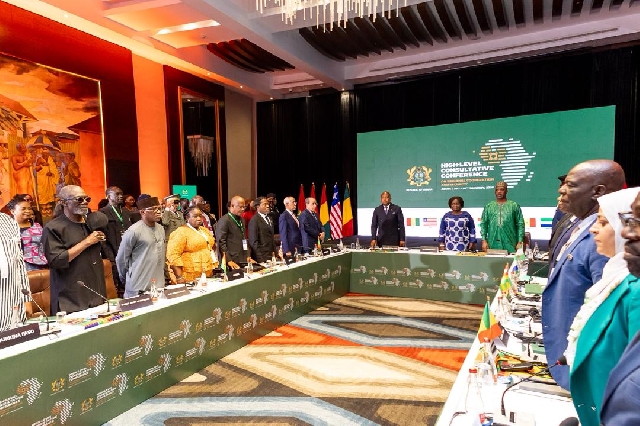 Vice President at Ministerial Conference
Vice President of the Republic of Ghana, Prof Jane Naana Opoku-Agyemang, has called for enhanced regional cooperation, proactive leadership, and practical policy coordination to address the evolving security challenges confronting West Africa and the wider region.
She made the call on Thursday, January 29, 2026, while delivering an address at the Joint Ministerial Meeting of the High-Level Consultative Conference on Regional Cooperation and Security in Accra.
Addressing Honourable Ministers, government officials, and regional stakeholders, the Vice President conveyed warm greetings from President John Dramani Mahama and underscored the importance he attaches to the conference, noting that the strong ministerial participation reflects the urgency of the challenges facing the region.
Prof Opoku-Agyemang described the Ministerial Meeting as central to the conference, stressing that it is the forum where analysis must be translated into concrete policy direction and national priorities aligned to guide regional action.
She observed that the region’s strategic environment has changed significantly, with security threats becoming increasingly interconnected and transnational.
According to her, challenges such as violent extremism, terrorism, organised crime, cyber threats, and persistent youth unemployment transcend national borders and institutional mandates.
“In this context, leadership requires more than responding to immediate pressures,” she said, adding that foresight and coordination are essential to ensure that security strategies, foreign policy, and development agendas reinforce one another rather than operate in isolation.
The Vice President cautioned against fragmented approaches, noting that experience within and beyond the region has shown such methods to be ineffective in addressing today’s complex threats.
She emphasised that effective regional cooperation must be anchored in timely information-sharing, joint analysis, and coordinated responses, with prevention serving as a practical necessity rather than an abstract ideal.
Professor Opoku-Agyemang further stressed the need for regional initiatives to be designed with implementation clearly in mind, highlighting the importance of defined roles, strong institutional frameworks, and alignment with national priorities. Without these, she warned, cooperation risks remaining aspirational instead of operational.
She also underscored the role of credible and capable institutions, noting that even well-crafted policies yield little impact if coordination is weak or mandates are unclear.
Sustained progress, she said, depends on institutional coherence, ownership, and the ability to translate decisions into tangible results.
The Vice President noted that the outcomes of the Ministerial Meeting would directly inform the deliberations of Heads of State and Government at the Summit scheduled for the following day, making the clarity of the ministers’ conclusions both immediately and long-term significant.
As discussions continued, she urged participants to balance ambition with realism, ensuring that recommendations reflect both the scale of the challenges and the institutional capacities of member states, while remaining grounded in national contexts.
While acknowledging the seriousness of the challenges ahead, Professor Opoku-Agyemang expressed confidence in the region’s ability to overcome them through sustained political commitment, coordinated action, and a focus on practical outcomes.
On behalf of President Mahama, she thanked the ministers for their constructive engagement and wished them a successful Ministerial Meeting.
Source: Classfmonline.com/Cecil Mensah


Trending News

GOIL CEO pays courtesy call on IGP to deepen fuel supply partnership for police operations
14:09
NE/R: GAF looks into alleged assault on journalist amid heightened security operations in Walewale, environs
18:50
UTAG-KNUST back calls for removal of GTEC leadership, cites incompetence
08:54
Ghanaian politician in U.S. cuatody over alleged domestic attack
12:22
Finance Minister paid nearly GHS10 billion in contractor arrears in December — Agbodza
15:04
Police arrest suspect linked to election day shooting in Kasoa Zongo
07:04
Not every woman is a wife, not every man a husband — Duncan-Williams speaks on marriage readiness
13:26
Supreme Court Kpandai ruling: Minority slams Parliament’s “premature” actions
13:55
Africa must strengthen resource sovereignty now: President Mahama urges, highlights Ghana’s GOLDBOD as model for value retention
18:41
Bono: Adedease-Asougya residents blame NPP for deplorable culvert projects
07:40