
Gov't targets 400,000 trainees under one million coders programme in 2026
Technology
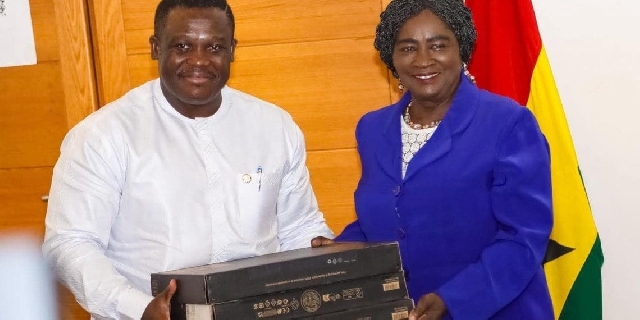 Sam George making a presentation to Veep
The government has set a target to train 400,000 Ghanaians this year under the flagship One Million Coders Programme, aimed at boosting digital literacy, employment opportunities and innovation across the country.
The target follows a successful pilot phase last year, during which 859 beneficiaries received training in coding and ICT-related skills.
The Minister for Communications, Digital Technology and Innovation, Mr Samuel Nartey George, disclosed this during a working visit by Vice President Prof Jane Naana Opoku-Agyemang to the Ministry on Thursday.
Mr George revealed that 20,000 custom-built laptops have already been procured, with plans to roll out training programmes in 100 constituencies by the end of the first quarter of 2026.
“Our goal is not just to train one million people, but to ensure that after training they can secure employment or remote jobs with internationally recognised certifications,” he said.
The One Million Coders Programme, a key initiative under President John Dramani Mahama’s RESET agenda, seeks to train one million Ghanaians over a four-year period in coding and ICT skills, equipping them for employment, remote work and participation in the global digital economy.
The Minister highlighted ongoing partnerships with global technology firms, including Google, MTN, Huawei and Telecel, to provide internationally recognised certification and enhance the employability of programme beneficiaries.
“Given the financial constraints, we reached out to Big Tech to support the President’s flagship programme, and the response has been very encouraging,” Mr George noted.
Beyond skills training, the Minister outlined major reforms underway within the Ministry and its agencies, including a comprehensive review of the legislative framework governing the ICT sector.
He said many existing laws were outdated and no longer fit for purpose.
According to him, 15 new and amended bills covering electronic communications, cybersecurity, data protection and digital economy development are at various stages and will soon be presented to Cabinet following stakeholder consultations.
To curb waste in government ICT procurement, Mr George said the Ministry is working with the Public Procurement Authority (PPA) and the National Information Technology Agency (NITA) to prevent duplication of systems across government institutions and safeguard sensitive national data.
“We’ve asked the Public Procurement Authority not to approve any government IT-related procurement without reference to NITA, so existing systems can be leveraged instead of paying for them twice,” he explained.
The Minister also disclosed that Ghana’s national artificial intelligence strategy is being developed in collaboration with the KNUST Responsible AI Lab and local industry partners, with the strategy expected to be launched by the end of the first quarter.
On institutional reforms, Mr George said the Ministry has adopted a fully paperless internal system, enabling digital processing of documents from receipt to approval.
Other achievements include significant improvements at Ghana Post, which delivered more than 100,000 biometric passports in under six months last year; the rollout of a fully digital system for inter-ministerial correspondence; and efforts to transition the .gh domain to state ownership to strengthen Ghana’s national digital identity.
Source: Classfmonline.com/Cecil Mensah


Trending News

Insurance Commissioner commends IBAG leadership, urges action to improve penetration
10:58
NPP January 31 Primaries: Osei Owusu calls on aspirants to honour results
13:17
Campaigners call for visa-free Africa by 2030 after 160-day continental journey
15:00
NPP primaries: Adutwum promises 'patriotic health insurance', scholarships, free university education as he campaigns in Volta Region
21:29
EC to complete printing of NPP ballots on Thursday
11:18
GA/R: Ningo-Prampram Assembly supports 46 PWDs with livelihood empowerment items
12:12
Karaga MP gives 4,000 gallons of fuel to boost livelihoods in New Year outreach
18:05
You can’t be a gangster and be part of the executive -Rachel Appoh advises A-plus
09:16
Kwame Nkrumah Memorial bark backs calls to rename Kotoka Airport to honour Nkrumah
10:59
Unauthorised buildings demolished by AMA at Awudome, North Kaneshie, tuesday market
12:48