

The global fertility shift: Why birth rates are falling — and why Africa matters
Feature Article
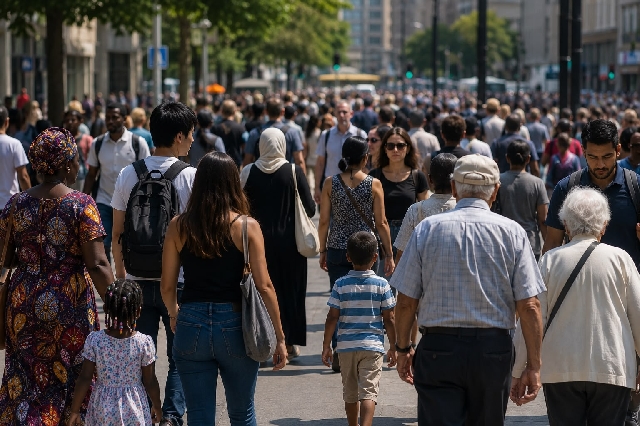 People of different generations and cultural backgrounds walk through a busy urban public space, illustrating the demographic diversity and population trends shaping societies around the world
As birth rates decline across much of the world, governments are grappling with ageing populations, shrinking workforces, and mounting economic pressures. Meanwhile, Africa's young and expanding population is emerging as a defining demographic force of the 21st century, offering significant opportunities alongside complex policy challenges.
For much of the last century, governments were preoccupied with rapid population growth. Today, many face the opposite challenge: falling birth rates, ageing populations, and mounting economic pressures. What was once regarded as a concern affecting only a handful of developed economies has become a global trend with far-reaching consequences.
According to the United Nations Population Fund (UNFPA), more than two-thirds of the world's population lives in countries where fertility has fallen below the replacement level of approximately 2.1 children per woman. United Nations projections indicate that much of the world's population growth over the coming decades will occur in sub-Saharan Africa, making the region central to the world's demographic future.
Behind these statistics lie millions of personal decisions. Rising housing costs, expensive childcare, job insecurity, and the challenge of balancing careers with family life are prompting many people to delay parenthood or have fewer children. For many households, starting a family has become as much an economic decision as it is a personal one.
The impact is already evident across Europe, East Asia, and parts of the Americas. Countries including Japan, South Korea, Italy, and Spain are grappling with ageing populations, shrinking workforces, and mounting pressure on healthcare and pension systems. Governments have introduced measures such as tax incentives, paid parental leave, and childcare subsidies; however, reversing the trend has proved difficult.
Africa has a distinct demographic profile. Although fertility rates are declining in many countries as education improves, urbanisation expands, and access to healthcare increases, they remain higher than in most other regions. Home to the world's youngest population, the continent has the potential to become a major driver of global economic growth if investment in education, healthcare, infrastructure, and employment keeps pace with population growth. Without sustained investment, rapid population growth could place greater strain on public services and deepen unemployment and inequality.
The transition is far from uniform. While many high-income countries face ageing populations and declining fertility, several low- and middle-income countries continue to have younger, expanding populations. These contrasting demographic trends are expected to shape migration, labour markets, investment, and economic development for decades to come.
Many developed economies increasingly rely on immigration to address labour shortages. At the same time, Africa's expanding working-age population could play an increasingly important role in the global economy if its potential is fully realised. The challenge lies in ensuring that policies and institutions adapt effectively to these changing demographic realities.
The United Nations identifies demographic change as a major force shaping societies throughout the 21st century, with significant implications for economic growth, healthcare, education, labour markets, and social protection. Governments will need comprehensive policies to respond effectively to these evolving population trends.
The global fertility shift is reshaping economies, labour markets, and public policy across continents. Decisions regarding education, healthcare, employment, migration, and family support will help determine whether these demographic changes become a source of resilience and shared prosperity or contribute to widening existing inequalities. In an increasingly interconnected world, demographic trends in one region will continue to shape opportunities and challenges across others.
Source: Yirinebe Sankono


Trending Features

Journalism beyond the headline: Reclaiming depth in a surface-level media culture
17:37
Act 1159: Ghana's Blueprint for a Sustainable Sporting Future
16:14
Explainer: How the Dennis 'Miracles' Aboagye controversy unfolded
11:44
Messi vs Ronaldo: Has the GOAT debate finally been settled — or is this football's greatest illusion?
12:13
Biometric verification rule: How will the ban on Ghana Card photocopying affect photocopy operators?
12:08
Ghana and French build a future of investment
09:59
One year on: How Gideon Boako is redefining constituency leadership
16:54
The global fertility shift: Why birth rates are falling — and why Africa matters
22:58
Europe's heatwave is no longer just a weather story — it's becoming an economic emergency
11:33
