
Sections of James Town traditional leadership reject scheduled general council meeting, question legitimacy
News
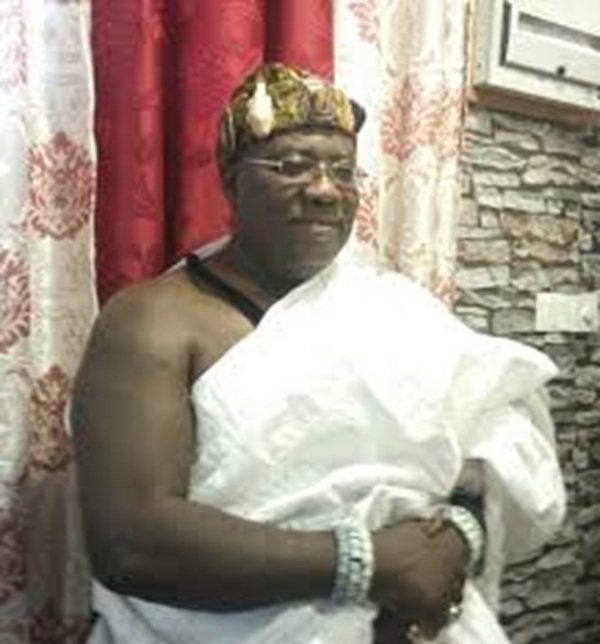 Embattled Prince Asharku Bruce Quaye
Strong opposition has emerged from segments of the James Town traditional leadership in the Greater Accra Region over the planned general traditional council meeting slated for Friday, January 30, 2026, at the Boxing Arena (Mudor Press Hall). Critics are challenging both the legitimacy and customary authority behind the announced gathering.
The Office of the Ngleshie Alata Paramount Stool had earlier stated that the meeting was convened in the name of the Ngleshie Alata Traditional Area under the authority of Prince Asharku Bruce Quaye.
However, traditional sources insist that the meeting lacks a proper customary foundation and should not be recognised as a legitimate traditional council sitting.
They argue that Prince Asharku Bruce Quaye is not vested with the authority to call stakeholder meetings, noting that he is not the Chief of James Town.
According to these sources, Nii Akonta Kojo III, the kingmaker of the James Town Paramount Stool, holds the customary mandate to convene or participate in meetings concerning chieftaincy, customs, or tradition.
Because he has enstooled Prince Asharku Bruce Quaye, the sources contend, the latter cannot assume powers he does not possess.
Under Ga custom, any failure to adhere to these ritual and procedural norms strips an individual of the authority to summon traditional stakeholders.
The dissenting traditional authorities further revealed that Dzassetse Nii Okpe, who has primary responsibility for enstoolment matters, confirmed that no individual by the name of Prince Asharku, also known as Wetse Kojo II, has been duly enstooled.
They noted that he was destooled as a sub-chief by his own family, rendering his claim to the paramount stool invalid.
Critics also dismissed Bruce Quaye’s adoption of the stool title “Wetse Kojo II,” explaining that the original Wetse Kojo, Henry George Vanderpuye, was installed in 1939, meaning any legitimate successor would be the third to bear the title.
They emphasised that Ga traditional law strictly separates the roles of those who enstool chiefs from those who remove them, and bypassing these processes constitutes a violation of customary governance.
While acknowledging that individuals may hold private meetings, the sources stressed that any gathering purporting to discuss chieftaincy, customs, or traditional governance must be convened by persons who are ritually clean and properly authorised.
On this basis, they have called for all traditional stakeholders to boycott the meeting if it proceeds under the guise of a traditional council session.
The sources reaffirmed that Naa Afrimpong III remains the only recognised queen mother empowered to convene meetings involving other queen mothers, and that only Dzassetse Nii Okpe and Nii Akonta Kojo are customarily authorised to summon traditional meetings within the Ngleshie Alata Traditional Area.
They warned that participation in gatherings convened outside established customary authority could attract serious traditional consequences, often referred to as being “judged by prosperity.”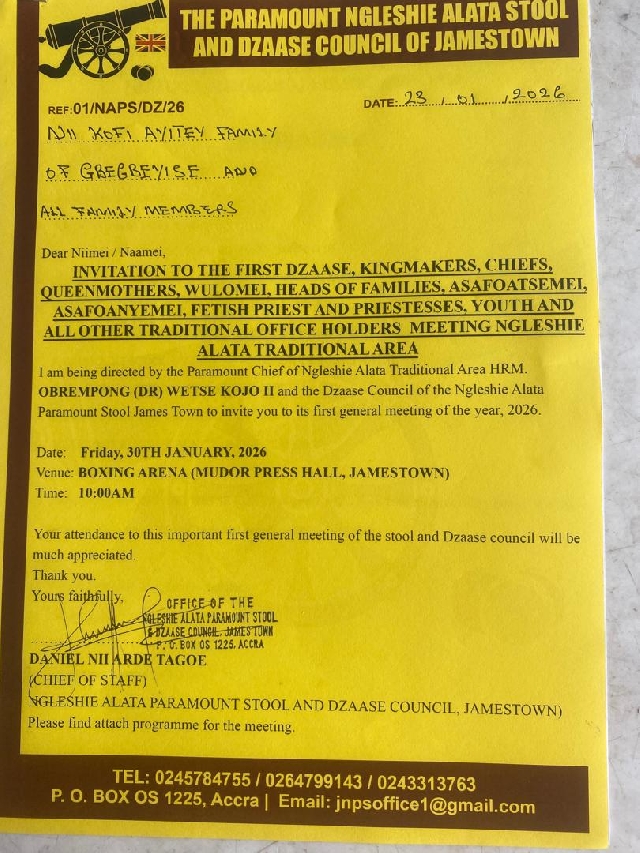
Source: Classfmonline.com/Cecil Mensah


Trending News

Lily Mohammed apologises for unsavoury remarks over iShowSpeed’s Ghanaian passport
10:20
Obuobia Darko-Opoku leads Mahama Cares to settle GHS210,840 surgery bill for midwife battling brain aneurysm under pilot programme
13:59
NYA hands over pick-ups to NAP coordinators for monitoring
18:07
Majority defends economic turnaround, praises 24-Hour economy vision
03:43
NPP supporter urges delegates to back Bryan Acheampong ahead of January 31 contest
11:52
Bawumia thank supporters in Ashanti region, urges unity ahead of NPP presidential contest
11:03
Bawumia presents NPP best chance of winning 2028 polls – Egyapa Mercer
08:20
Tema East MP coordinates emergency water supply for Manhean SHTS amid pipeline disruption
08:48
Bawku: Pro-Bawumia supporters allege threats ahead of Presidential Primaries, call for security intervention
09:56
A/R: Police destroy millions of cedis’ worth of illicit drugs seized in regional operations
14:34
