
Gender-Based Violence persists in Ghana as survivors struggle to report abuse – FIDA reveals
General News
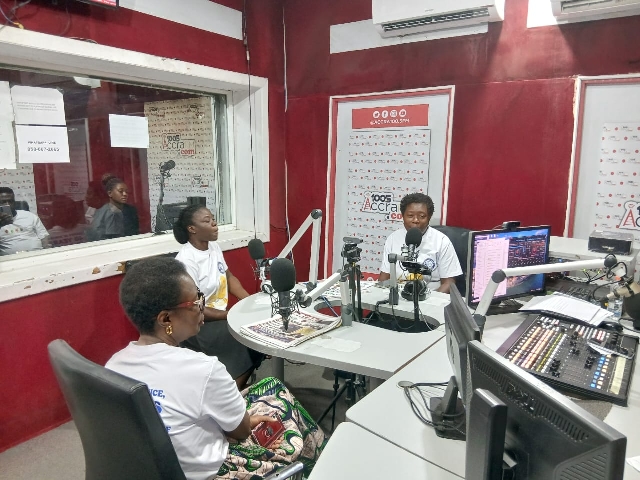 FIDA team in Accra FM studio
Concerns about the persistent underreporting of Gender-Based Violence (GBV) in Ghana took centre stage on Ghana Yensom morning show on Accra 100.5 FM as host Chief Jerry Forson engaged Noella Appiah, Programmes Manager at the International Federation of Women Lawyers (FIDA Ghana), in an in-depth discussion on the issue.
Responding to questions about whether the situation is getting worse or improving, Ms. Appiah explained that although there has been some progress over the years, the problem remains widespread, with many survivors still unable or unwilling to report abuse.
According to her, FIDA’s data shows that cases continue to exist, but several barriers prevent women from seeking justice.
She revealed that FIDA conducted extensive research to understand why survivors of maltreatment often do not report abuse.
Key findings pointed to fear, lack of information, cultural pressures, weak support systems, and limited access to services—especially in rural areas.
Even in Accra, she noted, many women are unaware of available services such as the Domestic Violence and Victims Support Unit (DOVVSU) and one-stop centres.
Ms. Appiah further explained that some survivors begin the reporting process but later withdraw due to family pressure, concerns about family reputation, fear of broken homes, or anxiety about court procedures.
In other cases, financial constraints discourage victims, particularly when hospital bills are involved, despite the Domestic Violence Act providing for free medical care.
To address these challenges, FIDA developed a position paper and carried out a budget analysis to assess funding for the Ministry of Gender, Children and Social Protection, particularly allocations to the Domestic Violence (DV) Fund.
She disclosed that funding has been historically low, with over 80 percent reductions in previous years.
Although the 2026 budget shows an increase from about GHS300,000 to GHS1 million, she stressed that the amount remains inadequate.
“Even with GHS1 million, the funds are not enough,” she said, explaining that servicing survivors—starting from Accra alone—would quickly exhaust the allocation before reaching other regions.
She therefore called for the decentralisation of the DV Fund and the establishment of clear guidelines to ensure easy access for survivors.
Ms. Appiah also emphasised the need for transparency and accountability, suggesting that the Ministry regularly reports on how many survivors are supported, how much is spent, and how capacity-building efforts are progressing.
This, she said, would help stakeholders project realistic funding needs and strengthen advocacy.
Chief Jerry Forson supported her concerns, questioning whether current budgetary allocations truly reflect the scale of the problem.
Both agreed that sustained advocacy, proper research, and stronger systems are critical to improving reporting, survivor support, and ultimately reducing Gender-Based Violence in Ghana.
She took the opportunity to thank the African Women Development Fund, UNDP and UNFPA for the support


Trending News

Former Akufo-Addo–appointed MMDCEs demand payment of ESB
13:12
IGP Special Operations Team arrests suspected drug peddlers in Tamale crackdown
12:57
E/R: Bee attack injures several residents in Abotanso community
13:03
Adwoa Safo defends Bawumia, urges NPP delegates to reject blame over economy
11:50
Ex-footballer says he was wrongfully jailed after ‘hook-up’ encounter; claims police freed key suspect after allegedly taking bribe
12:38
Gov't to introduce awards scheme for cleanest regions, districts: President Mahama announces
13:47
Ghana chamber of mines urges government to pause mining royalty reforms
12:50
Ghana Library Authority begins review of 55-year-old law establishing it
12:42
HIV cases rise in Volta Region amid poor condom use among youth
13:15
NDC Legal Director expresses concern over confusion surrounding Daddy Lumba’s funeral
12:20