
Leonardo DiCaprio 'fights' Akufo-Addo over mining bauxite in the Atewa forest
General News
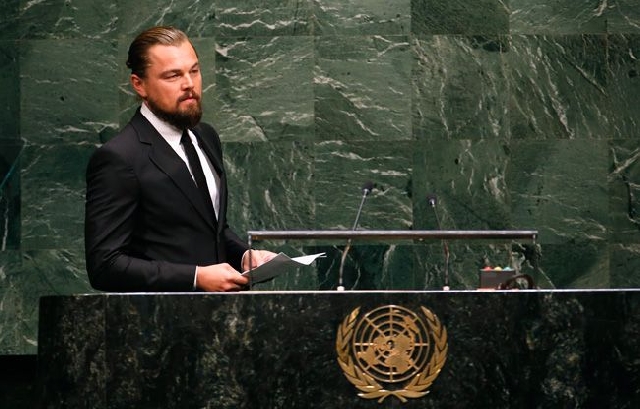 Actor and environmentalist Leonardo DiCaprio
International movie star Leonardo DiCaprio, who is also an environmentalist dedicated to the protection and wellbeing of all earth's inhabitants, has kicked against President Nana Addo Dankwa Akufo-Addo and his government’s plan to mine bauxite in the Atewa forest reserve in Ghana’s Eastern Region.
The actor, who played a lead role in the movie 'Titanic', said the forest is at risk of extinction if it is mined.
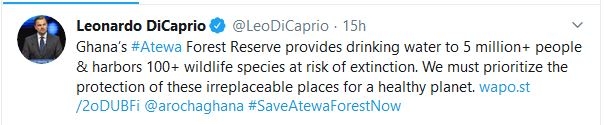
With the knowledge that the forest provides drinking water to five million people and harbours over 100 wildlife species, DiCaprio, in a tweet, said: “We must prioritise the protection of these irreplaceable places for a healthy planet.”
The forest is the source of three major rivers that provide water for five million Ghanaians. The Densu River, which flows from the Atewa Forest, feeds the Weija Reservoir that provides close to 2.5 million people in Accra with water.
It is also home to an estimated 165 million tonnes of bauxite, a sedimentary rock used to create aluminium products such as aircraft parts, kitchen utensils and beer cans.
The government of Ghana has, however, entered into a barter agreement – the Sinohydro deal – with Asian powerhouse, China, to mine Ghana’s bauxite in the forest reserve in exchange for $2 billion for infrastructural development in the West African country.
Despite opposition from a number of groups for the government to withdraw the agreement, President Akufo-Addo insists the mining of bauxite in the Atewa forest will be guided by best international practices and technology to ensure that the wildlife in the mining environment is not endangered.
Addressing the Sustainable Ocean Industries Conference organised under the auspices of the Petroleum Commission of Ghana, Aker Energy and the Norwegian Embassy in Ghana, as part of a two-day state visit by the Prime Minister of Norway to Ghana at the Labadi Beach Hotel, President Akufo-Addo, in an answer to a question about whether or not the mining of bauxite in the forest will not compromise the environment, said it was a very legitimate balance that ought to be struck and that the leadership of the country was looking to achieve the same balance.
"The technology of today is much more sensitive to these issues because of the pressure that is being brought on the bauxite and oil companies to take it into account. So, to some extent, beginning now, the full-scale exploitation of Ghanaian bauxite resources, we are in a better place, technology-wise, than we would have been 20, 30 years ago," the President said.
The Ghanaian leader further stated that: "I am satisfied by what I have been told and what has been demonstrated to me that it is possible for us to get that red mud out without disturbing the wildlife there is in the Atewa mountains".
Meanwhile, Mr Ronald Abrahams, a chief officer of the Water Resources Commission, the government agency tasked with managing the use of Ghana’s water resources recently told the Washington Post that: “When you take the mountain off, you change the hydrology and ecology,” adding that: “It will not be the same. It will change everything, and we won't have a source of a river which is so reliable and has served this nation for ages.”
The Christian Council of Ghana, an association of religious bodies, has also appealed to the government to reconsider its decision.
The Council said in a letter to the President that: “The extraction of bauxite will undoubtedly require the forest to be removed since the deposits are only within the top few metres of the horizon and spread over a wide area… The resulting landscape will be impossible to restore to its former condition because the organic layer will be removed during the mining and it would probably take centuries for the lost flora and fauna to be re-established if they are not entirely extinct.”
The Christian Council said instead of mining, the government should rather establish a national park in the forest. “Establishing a new national park is an option with great public support amongst the forest-urged communities who are so dependent on the forest. A new national park at Atewa forest can deliver sustainable jobs and livelihoods for many people and, as part of a living landscape, can provide new economic opportunities”.
What does Ghana stand to gain from the deal?
China has already released the first tranche of the $2 billion to the government of Ghana, Vice-President Dr Mahamudu Bawumia disclosed on Monday, 11 November 2019.
Apart from that, China has offered other financial support to Ghana made up of a 300-million Yuan (approximately GHS236.18/$42.79m) grant and a debt write-off of 250 million Yuan (approximately GHS196.82m/$35.66m).
Despite these benefits, campaigners, water experts and environmentalists say the environmental cost will be too high for Ghana to bear.


Trending News

UTAG-KNUST opposes GTEC plan to harmonise academic promotions
10:03
After 8 years in court, June 3 disaster victims hope for justice as GHS40m compensation case nears judgment
10:37
High-profile ORAL trials continue in court this week
14:24
Interior Minister announces security reforms and tighter citizenship requirements
02:45
Chairman Wontumi calls for party unity ahead internal elections
10:02
Government recruiting 10,000 Teachers and lecturers to address staffing deficit — Haruna Iddrisu
16:34
Accra–Kumasi Expressway: gov’t clears 51km stretch, compensation to begin in June
08:56
Fire breaks out at Accra Central Police Barracks; no casualties reported, suspect in custody
02:51
Eric Opoku unevils bold reforms to attract private investment into Ghana's rice value chain
10:11
GES announces 2026/2027 academic calendar for SHSs and TVETs
14:21