

Drop in WASSCE 2025 performance – Reality check and opportunity for correction?
Feature Article
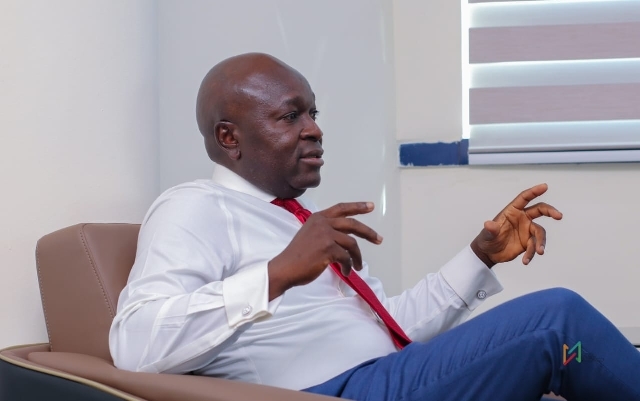 Alhaji Seidu Agongo is a businessman and philanthropist
Last week, the West African Senior School Certificate Examination (WASSCE) released the 2025 results, sparking intense debate across the country.
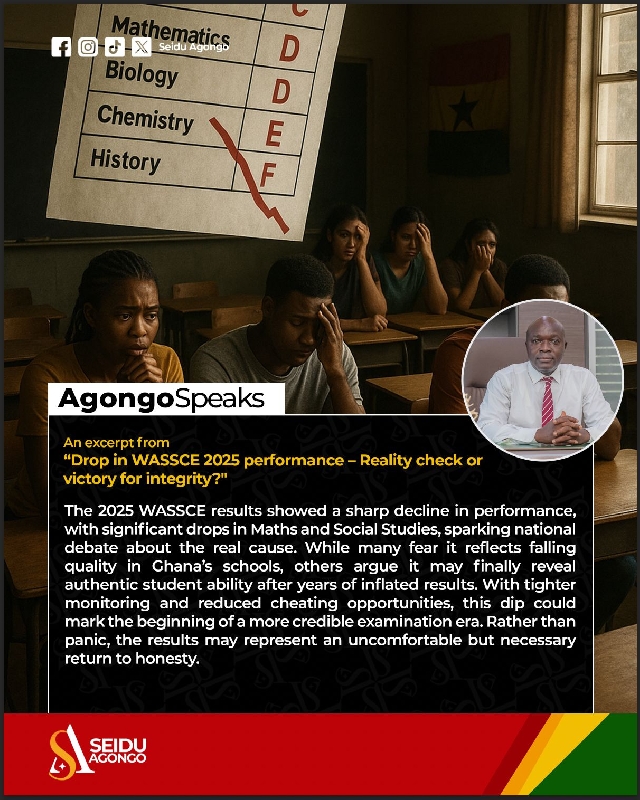
After years of impressive pass rates under the Free Senior High School (Free SHS) policy, this year’s results show a sharp decline in performance.

Passes in Core Mathematics pass rates fell from 66.86% in 2024 to 48.73%, while Social Studies dropped from 71.53% to 55.82%. English and Integrated Science recorded slight declines but remained relatively stable, according to the results.
For many watching developments in the education sector, this downturn raises a critical question: Is this a sign of falling quality in our schools, or the result of a deliberate crackdown on examination malpractice?
For me, this decline is not a failure. It could signal a necessary correction.
Historic surge in infractions
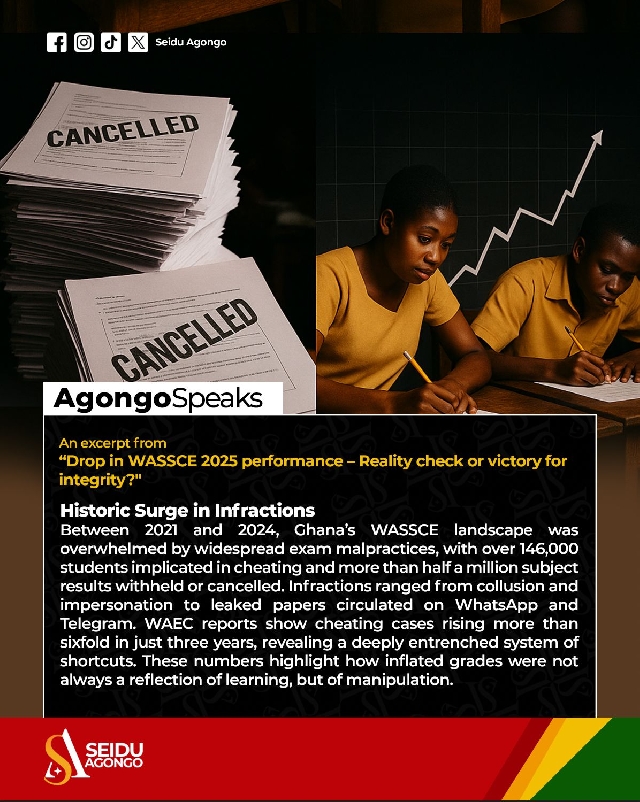
Between 2017 and 2024, statistics show that the country’s WASSCE results were plagued by systemic malpractice, with the West Africa Education Council (WAEC) data showing sharp increases.
From 2021 to 2024 alone, 146,309 candidates were implicated in cheating schemes. Cheating incidence rose by more than six folds, from 10,386 cases in 2021 to 62,046 in 2024.
In effect, 13.6% of candidates who sat for the 2024 WASSCE exams were implicated in exam malpractices!
The data show that common infractions between this period included collusion, smuggling of foreign materials, impersonation, and digital leaks via social media platforms such as WhatsApp and Telegram platforms.
WAEC’s five-year statistics further reveal that over 532,000 subject results were withheld and nearly 39,000 cancelled in 2024 alone, with hundreds of entire results annulled annually.
Despite these disturbing statistics, prosecutions were historically rare until recent years.
Integrity push
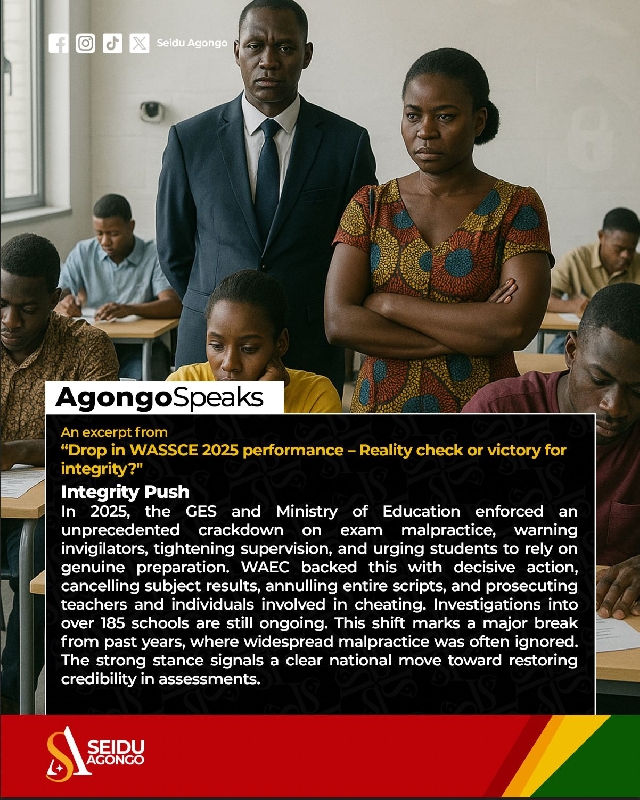
It can be recalled that following the years of exam malpractices, the Ghana Education Service (GES) and the Ministry of Education this year vowed a zero-tolerance stance on cheating ahead of the exams.
Invigilators and supervisors were warned of immediate dismissal if found aiding malpractice, while candidates were urged to rely on their preparation rather than leaked materials.
It appears the exam body, WAEC followed through, given the outcome of the exams.
The results showed that WAEC cancelled subject results for 6,295 candidates, annulled entire results for 653 candidates, and withholding results for hundreds more.
Outside exams, investigations into alleged collusion in 185 schools are ongoing. Notably, 35 individuals, including 19 teachers, have faced prosecution, with 19 already convicted.
This unprecedented enforcement contrasts sharply with previous years, when civil society groups like Africa Education Watch (Eduwatch) repeatedly flagged systemic malpractice with little consequence.
It does appear that for too long, we allowed a culture of shortcuts to thrive to be able to present a particular image about our education system and its products.
Eduwatch’s Executive Director,Mr Kofi Asare, has long argued that unrealistic performance targets for schools and political pressure to showcase the Free Senior High School (SHS) program’s success fueled widespread cheating.
Mr Asare once cautioned that the education system had shifted toward prioritising exam scores over real learning and urged the adoption of technology-driven solutions, such as installing CCTV cameras in examination halls, to restore integrity.
Free SHS and quality debate
The Free SHS policy undeniably expanded access, lifting financial barriers for hundreds of thousands of families.
As a son of humble beginnings, I am fully aware of how financial burdens kill dreams, partly explaining why I have supported hundreds of brilliant needy students and underprivileged people to access education and opportunities that fund schooling.
But critics say the rush for quantity under the Free SHS and the general attempt to present the program as the best, insulates it from proper critique necessary to strengthen quality and sustain it.
It is recalled that university lecturers reported alarming gaps in foundational skills among Free SHS graduates, with some institutions even considering entrance exams to bridge deficits.
“We’ve sacrificed quality for quantity,” Professor Martin Oteng Ababio, a senior University of Ghana lecturer, lamented in September 2024, citing overcrowded lecture halls and underprepared students.
This year’s results may therefore reflect a system recalibrating from inflated grades to genuine merit as explained by both the GES and the Ministry of Education.
That is why this year’s results is not a failure but a painful and necessary correction.
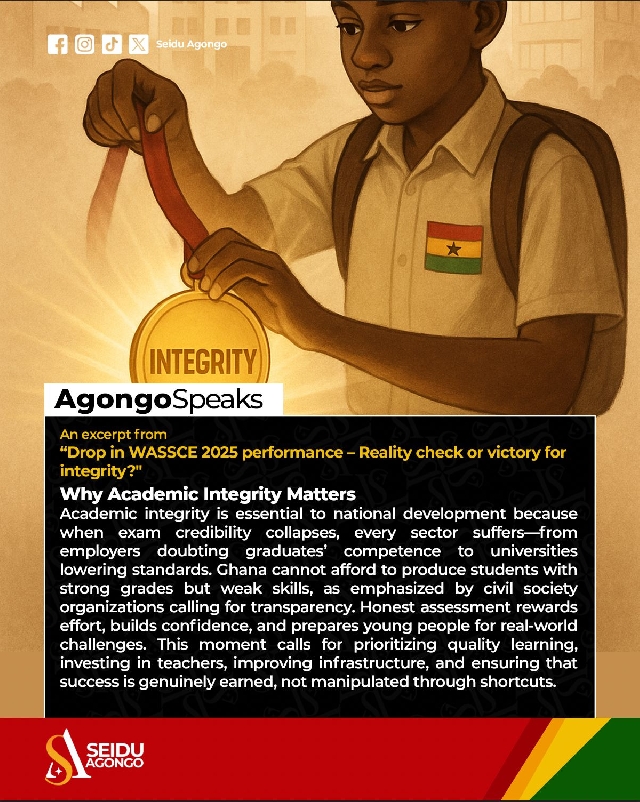
Why academic integrity matters
Education is the bedrock of national development. When certificates lose credibility, the entire economy suffers, from employers questioning graduate competence to universities lowering standards to accommodate ill-prepared entrants.
Ghana cannot afford to produce “excellent grades but hollow minds,” as the nonprofit, LEADIF warned in its call for radical transparency in exam administration.
Integrity in assessment ensures that success is earned, not bought or leaked. It rewards hard work, builds confidence, and nurtures a generation equipped for innovation and leadership.
For businesspeople and education advocates like us, this is the moment to champion quality over quantity and to invest more in teacher training, infrastructure, and technology that supports honest learning.
Way forward
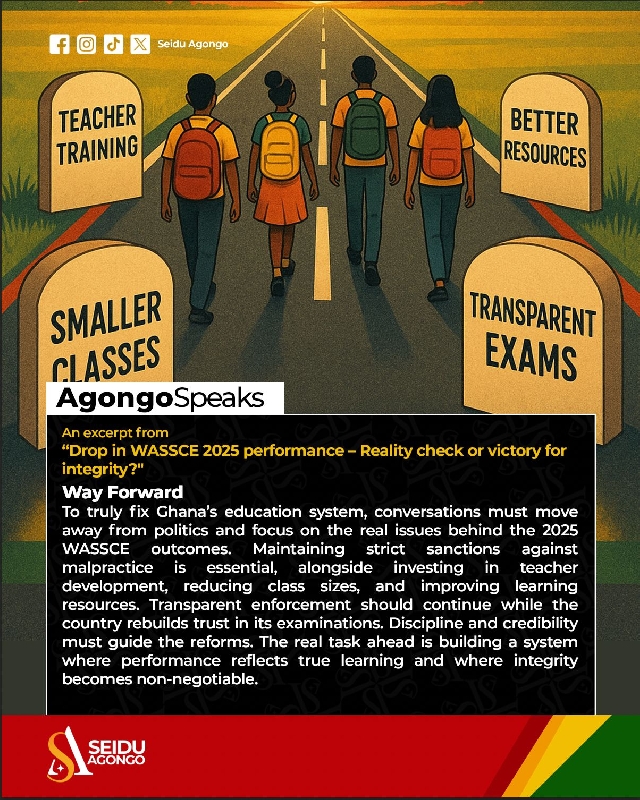
While it is important to find the root cause the 2025 WASSCE results to be able to institute measures against a repeat, it is advisable to detach politics and emotions from the debate and focus on how to reset the entire education system to regain the confidence of external stakeholders.
In the meantime, we must continue to maintain the crackdown on malpractice with transparent sanctions, invest in stronger teaching through smaller classes, better resources, and continuous teacher training, and remove politics from education so performance reflects learning, not scorecards.
At this turning point, one truth stands out: discipline and integrity are non-negotiable if we are to raise a generation capable of leading national progress.
The real question is not whether the drop in performance is embarrassing, but whether we have the courage to accept it as the price of restoring credibility to our education system.
The writer is a philanthropist and businessman
Source: By Seidu Agongo


Trending Features

Has the credibility of KGL turned Fourth Estate and Media Foundation For West Africa into bitter liars?
01:14
Economic witch-hunting: Ghana’s silent betrayal of its builders, the story of Alex Apau Dadey—the visionary who dared to build beyond politics
09:32
Stop letting Maths and Science decide Ghana’s future
13:56
President Mahama’s agro-industrial revolution: Turning Ghanaian farms into business powerhouses
12:19
Laud Nartey: Growing unethical behaviour among bank staff- why BoG, GAB must scale up surveillance
07:02
Trapped in a cycle of danger: blood in the recycling factory
12:23
A new Africanism is rising: Why identity matters now
09:26
Kumasi High Court gripped by battle over Daddy Lumba’s widowhood rites
09:13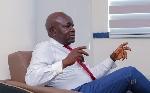
Drop in WASSCE 2025 performance – Reality check and opportunity for correction?
09:45