
Beyond the clinic walls: Strengthening rural CHPS compounds through community partnerships and accountable governance
Feature Article
 ACGS (Pic):
For many rural Ghanaians, a Community-Based Health Planning and Services (CHPS) compound represents their sole avenue for healthcare, apart from transfers to distant district health facilities. Essential services such as maternal care, immunisations, and treatment for prevalent illnesses are contingent on these local compounds; unless care is provided at these locations, it often does not happen at all.
Unfortunately, the individuals tasked with running these facilities operate under immense constraints. If you ask a health worker at a CHPS compound about their daily reality, they will likely recount a familiar narrative: insufficient medicines, unreliable equipment, intermittent power and water supplies, and inadequate means of patient transport during emergencies. The living conditions for staff are often as inadequate as the facilities they serve. The perseverance of these healthcare workers, who commit day after day to never turning away a patient, is what keeps the clinics operational.
However, this situation has dire implications for the most vulnerable populations: pregnant women, nursing mothers, children, the elderly, and individuals managing chronic illnesses. These groups are the ones who turn up at the clinics, especially when resources run low, often with no alternative for care.
The Kanvili Health Centre in the Sagnarigu Municipality exemplifies the challenges facing rural healthcare. Between August and December 2025, the centre reported 44 deliveries, over 700 antenatal care visits, and nearly 1,700 outpatient cases of malaria, all through one primary facility, bolstered solely by its proximity to Tamale. Alarmingly, malaria has consistently been the primary diagnosis, occurring at three to four times the frequency of the next most common ailments. This trend is not merely a temporary spike; a comprehensive review of morbidity data reveals that malaria has topped the list annually from 2023 to 2025, with respiratory tract infections and gastroenteritis fluctuating in prevalence behind it.
The Role of NGOs in Filling the Gaps Left by Government
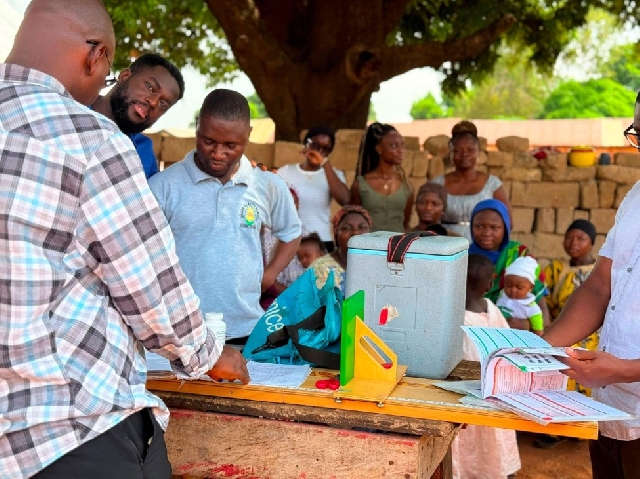
ACGS Community outreach with GHS Staff
Across numerous rural communities, a concerning trend is evident: clinics often rely on donations for essential supplies, equipment, and outreach fuel. NGOs, religious organisations, philanthropic groups, and local associations are quietly sustaining a public health infrastructure that ought to be self-sufficient.
While this external support is undoubtedly lifesaving, it also raises critical alarms. A robust health system should not hinge on the availability of NGO resources in any given district from year to year; this is not resilience, but rather an indication of systemic improvisation in lieu of coherent policy.
In Kanvili, the consequences of this improvisation are unmistakable. The community once had a sizable communal waste bin provided by the district assembly, which was emptied but never replaced. Residents, anticipating its return, continued to deposit refuse at the same site, resulting in a permanent eyesore. Households unable to afford private sanitation rely on a single public toilet, which many residents deem impractical because of its distance from homes. This predictable scenario leads to open defecation, stagnant wastewater buildup, and standing water that fuels the mosquito population and exacerbates malaria cases.
Listening to the Voices of the Community
ACGS Team is engaging community members at Sakora
ACGS conducted community health outreach sessions in Kanvili, Choggu, Bagabaga, and Ward K, all within the Northern Region. These sessions aimed not just to deliver services, but to foster direct dialogue among healthcare workers, chiefs, and residents.
In Choggu and Bagabaga, community members vividly described their struggles to obtain care when the nearest compound is lacking basic supplies. Health workers in Kanvili candidly outlined their critical shortages, particularly of reliable diagnostic equipment. Traditional leaders in Ward K emphasised that addressing these issues requires collective responsibility, not solely reliance on government action.
While this may not be new information, experiencing these realities firsthand from community members, rather than through reports, significantly alters its impact. This firsthand feedback is corroborated by formal community health assessments, which reveal that when Kanvili residents ranked their priorities, access to potable drinking water emerged as the paramount issue, surpassing waste management, drainage, sanitation, and even health education. Maternal and child health services ranked last, not due to a lack of value but because residents recognise water and sanitation as foundational problems contributing to their health challenges.
Recognising the Governance Dimension of Health Issues
The existence of under-resourced clinics does not occur in isolation. They are symptomatic of systemic issues such as inequitable public funding, a lack of support for frontline workers, and insufficient citizen participation in decisions affecting their healthcare.
To truly remedy these challenges, action must include:
- Genuine investment in the infrastructure and equipment of primary healthcare.
- Timely provision of medicines and supplies to healthcare facilities.
- Enhanced housing and incentives for rural health personnel.
- Collaborative efforts among district assemblies, the Ghana Health Service, traditional authorities, and civil society, working in concert rather than at cross-purposes.
Addressing these interconnected challenges requires a comprehensive commitment to accountable governance and community collaboration, ensuring that rural health facilities can thrive and adequately serve their populations.
The people running these compounds are doing it with almost nothing. Ask a health worker posted to one what a normal day looks like, and you'll hear a version of the same story: not enough medicine, unreliable equipment, power and water that come and go, and no good way to move a patient in an emergency. Staff housing is often as rough as the clinic itself. What keeps these places open isn't top-down planning; it's individual workers deciding, day after day, not to turn a patient away.
That has consequences that land on specific people. Pregnant women, nursing mothers, children, the elderly, anyone managing a chronic illness — they're the ones who show up when the compound is short on basics, and there's often nowhere else for them to go.
Kanvili Health Centre, in the Sagnarigu Municipality, is a working example of exactly this pattern. Between August and December 2025, the facility logged 44 deliveries, over 700 ANC visits, and nearly 1,700 outpatient cases for malaria alone, all through a single primary facility backed up by proximity to Tamale, and nothing else. Malaria showed up as the leading diagnosis every single month, at roughly three to four times the volume of the next most common condition. That's not a one-off spike. A three-year review of morbidity at the centre shows malaria has held the top spot every year from 2023 through 2025, with respiratory tract infections and gastroenteritis trading places behind it.
When NGOs fill the gap the government has left open
Spend enough time in communities, and a pattern shows up fast: rural clinics are running on donated equipment, donated medicine, and donated fuel for outreach trips. NGOs, faith groups, philanthropists, local associations, they're quietly propping up a public service that shouldn't need propping up. That helps matters, and it's kept people alive. But it's also a warning sign. A country's health system shouldn't depend on which NGO happens to be active in a given district that year. That's improvisation standing in for policy, not resilience.
In Kanvili, that improvisation is visible on the ground. The community once had a large communal waste bin provided by the district assembly. It was emptied, never returned, and residents kept dumping refuse at the same spot anyway, expecting the bin to be back. Years later, that spot is a permanent heap. Households that can't afford a private toilet rely on a single public facility that, by residents' own account, sits too far from most homes to be practical. The predictable result: open defecation, stagnant wastewater behind houses, and standing water that breeds the mosquitoes driving the malaria numbers above.
What people actually said
The African Center for Governance Studies (ACGS), ran community health outreach sessions in Kanvili, Choggu, Bagabaga, and Ward K, all in the Northern Region. The point wasn't just about delivering services; it was about getting healthcare workers, chiefs, and residents to talk to each other directly, in the same room.
In Choggu and Bagabaga, residents described what it's actually like trying to get care when the nearest compound is short on basics. Health workers in Kanvili were blunt about what they're missing; reliable diagnostic equipment came up more than once. In Ward K, traditional leaders said, more than once, that fixing this isn't the government's job alone.
None of this is new information, honestly. But hearing it directly from people in these communities, rather than reading it secondhand in a report, changes how it lands. It also aligns with findings from a formal community health assessment in which Kanvili residents were asked to rank their own priorities. In a pairwise ranking exercise, where each identified problem is weighed head-to-head against every other, potable drinking water came out on top, ahead of waste management, drainage, sanitation, and even health education itself. Maternal and child health services ranked last, not because residents don't value them, but because they had already identified water and sanitation as the upstream cause of most of what was landing people in the clinic in the first place.
This is a governance problem, not just a health problem. Under-resourced clinics don't happen in a vacuum. They happen when public money isn't allocated fairly, frontline workers have no backup, and citizens have no real say in decisions about their own care.
Fixing it means:
- Actually investing in primary healthcare infrastructure and equipment
- Getting medicine and supplies to facilities on time, not eventually
- Better housing and incentives for rural health staff
- District assemblies, the Ghana Health Service, traditional authorities, and civil society are working together instead of working in silos
- Real transparency in how health resources get allocated and spent
- Giving communities an actual role in planning and monitoring local health services
None of this is complicated. It takes political will, not new ideas.
A community-led proposal developed for Kanvili put a number on what that political will would actually cost: roughly GH₵383,581 to build two new public toilets, renovate a third, drill boreholes, and provide the community with proper waste bins. That's a modest figure against the scale of an 8,749-person community, and it's the kind of number that shows the problem was never mysterious; it was never funded to begin with.
Communities are taking initiative and not waiting around
One thing came through clearly across Kanvili, Choggu, Bagabaga, and Ward K: communities aren't sitting back waiting for someone else to fix this. Residents want to be part of the solution, and health workers keep showing up despite everything working against them.
In Kanvili, that shows up in small, unglamorous ways: households digging their own wastewater pits because no one else will, families improvising dustbins out of boxes and wooden containers, health centre staff running repeat hygiene education sessions on their own initiative, year after year, without waiting for a budget line to appear. But goodwill has a ceiling. A health worker's dedication doesn't fix a broken supply chain, and a community's patience doesn't replace a working budget line. Rural health workers deserve to do their jobs without also having to solve equipment shortages on their own time.
Where this needs to go
Ghana aims at Universal Health Coverage (UHC) by 2030 and one of the means of getting there is through the expansion of the National Health Insurance Scheme, which currently has over 20 million active users. The CHPS compounds are the easiest and least costly way for the nation to ensure that all citizens, whether in rural or urban settings, have access to healthcare. That goal is only as real as its weakest CHPS compound. Every properly equipped facility means fewer emergencies turn into tragedies, and that is what the UHC actually rests on, not the policy documents.
ACGS keeps doing this work: pushing for accountable health sector governance, backing evidence over guesswork, and making sure communities have a seat at the table on services they depend on. That means working alongside government, development partners, traditional authorities, and citizens, not around each other.
Ghana's rural health workers have earned recognition for what they are doing with almost nothing. What they actually need is for someone to fix the "almost nothing" part.


Trending Features
Biometric verification rule: How will the ban on Ghana Card photocopying affect photocopy operators?
12:08
Ghana and French build a future of investment
09:59
One year on: How Gideon Boako is redefining constituency leadership
16:54
The global fertility shift: Why birth rates are falling — and why Africa matters
22:58
Europe's heatwave is no longer just a weather story — it's becoming an economic emergency
11:33
Explainer: Why was Chairman Wontumi jailed, and what happens next?
21:46
Today is Zero HIV Stigma Day: 1,200 babies. And the word we used to explain it
17:04
Beyond the clinic walls: Strengthening rural CHPS compounds through community partnerships and accountable governance
16:56
Journalism beyond the headline: Reclaiming depth in a surface-level media culture
17:37
Act 1159: Ghana's Blueprint for a Sustainable Sporting Future
16:14