

Apostle Samuel Oduro calls for support to scale up local Apple production
Business
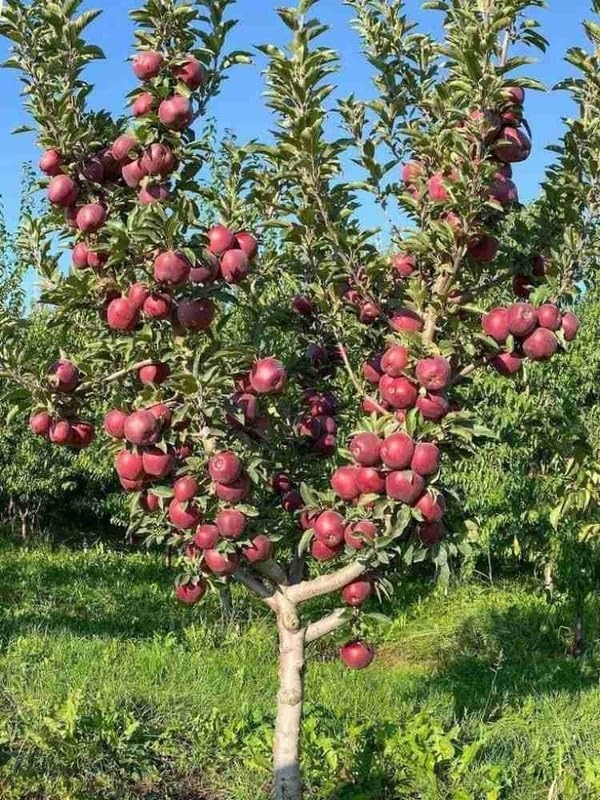 Apple tree
Apostle Samuel Oduro, the farmer who has defied long-held beliefs that apples cannot grow on Ghanaian soil, is appealing to government and private investors to support the expansion of local apple production.
Speaking in an interview with Asona Dehyie Kwateng at his apple farm in Asante Mampong, Apostle Oduro called on the Ministry of Food and Agriculture (MoFA) and other stakeholders to provide critical support, including irrigation dams, specialised agro-chemicals and financial incentives, to help scale up production.
According to him, such support would enable Ghana to reduce its heavy dependence on imported Apples and move towards self-sufficiency, with significant benefits for the national economy.
“Working on this has been very difficult because Apple cultivation is not common in this climate,” he said.
“I am appealing to the government, as a matter of urgency, to come to my aid.
Expanding local Apple production will reduce the burden on importers and greatly boost the economy.”
Apostle Oduro explained that his success is rooted in years of experience gained while farming apples abroad.
Upon returning to Ghana, he set out to prove that the fruit could thrive in Mampong, despite widespread scepticism from experts who believed the soil and climate were unsuitable.
His efforts have since paid off, with locally grown Apples from his farm already finding their way to the market.
Traders, particularly market women, are now retailing the produce to the public as “Ghana-grown” apples.
The pioneer farmer further urged the Ministry of Food and Agriculture to collaborate with him to replicate the initiative in other parts of the country.
Drawing a historical parallel, he said his ambition is to do for Apple what Tetteh Quarshie did for Cocoa in Ghana.
Meanwhile, roadside apple sellers have welcomed the initiative, describing it as a major relief for traders and consumers alike.
They noted that the high cost of imported apples—driven by shipping charges and exchange rate pressures—often pushes prices beyond the reach of many customers.
“Having large-scale local production would be very helpful,” one trader said.
“Imported apples are too expensive, and that affects our sales.
If we can get them produced here in Ghana, it will improve our businesses and make Apples more affordable for customers.”
Source: Classfmonline.com/Cecil Mensah


Trending Business

Black Stars' World Cup exit leaves jersey traders facing slow sales, price cuts
17:31
CSA warns of surge in online investment scams as Ghanaians lose over ¢3.4m
21:01
Government settles US$700 million Eurobond obligation ahead of schedule
19:31
GRDA reactivates Accra-Koforidua line, wins $21m EU grant to fix Tema-Mpakadan signals
15:42
Government moves to support maize and bean farmers in Atebubu-Amantin
02:50
Government seeks land in Akyem Abuakwa for major palm processing factory
00:41
Mahama pledges better pensions as economy recovers
22:46
Bank of Ghana records 26.7% increase in registered security interests in 2025
03:03
Cashew Council Ghana inaugurates new governing board
02:57
COCOBOD releases ¢2.6b to licensed buying companies for farmer payments
23:25
